Showing posts with label biodiversity. Show all posts

Friday, October 4, 2013

Mt. Bulusan : 'A Special Place in Philippine Botany'

Palali (sometimes pronounced/spelled as Palale) is a pure white katmon relative that flourishes abundantly in the mountains of Bulusan. http://phytoimages.siu.edu/imgs/pelserpb/r/Dilleniaceae_Dillenia_reifferscheidia_75128.html
Receiving encouraging words from no less than a distinguished scientist was one of the  most rewarding experiences in my personal foray into flora photography in my hometown.

Dr James LaFrankie, author of the book  An Illustrated Guide on Asia's Tropical Trees posted the following in the FB page of the Co's Digital Flora of the Philippines :
"...you are getting a great collection of photographs of all sorts of interesting plants... Mt. Bulusan is a special place in Philippine botany so keep building your collection..."

Dr James LaFrankie attained his PhD in Biology from Harvard University. He is now a professor at the Institute of Biology, College of Science at the University of the Philippines Diliman.

I did not expect that my simple contributions of flora photos from Bulusan will be noticed. My only aim is to at least make some listings with photos of the flora that are found in Bulusan. This encouragement therefore is a signal for me to continue this plant listing activity one species at a time for as long as I can still hold a camera to photograph these immense biodiversity.

Furthermore, this marvelous information that Mt. Bulusan is "a special place in Philippine Botany" also underscores the importance of the preservation of its natural conditions. For me it means that Mt. Bulusan and its adjacent areas must first and foremost be NOT converted into an industrial field such as that of a Geothermal field zone that will alter irrevocably its surrounding ecosystem.

Photo: Alma P. Gamil
BVNP - Bulusan Volcano Natural Park
Bulusan, Sorsogon, Philippines

Friday, August 9, 2013

Bulusan flora documentation starts with a modest gallery at PhytoImages


One of the many species of  Pandanaceae family in Bulusan
Bulusan biodiversity is hands down the richest in the Province of Sorsogon. Surprisingly no documentation of its existing flora can be accessed in the web or in any publication. An interview with a leading NGO in the municipality confirmed  this observation.


In this light, I have decided to speed up my gallery of plant photographs from Bulusan, my hometown, with each plant correspondingly identified and curated by PhytoImages' pool of experts.

For those interested to view the gallery, you may visit this page at Phytoimages.

The above photo of a Bulusan pandan species is included in the gallery. More photos are lined up for uploading in the next few days hopefully with the known scientific identification ready.

Photo: Alma P. Gamil
Bulusan, Sorsogon, Philippines


Sunday, May 26, 2013

Agoho and Bulusan Volcano


"The mountain agoho (Casuarina rumphiana), which is known to have a very limited distribution in the Philippines and Southeast Asia, inhabits this protected area," reads part of the assessment report re BVNP of the team of Errol Gatumbato a noted environmentalist in the Philippines.  By protected area, this refers to  BVNP, Bulusan Volcano Natural Park located in the composite mountains of Bulusan Volcano (above and below photos). 
Some of these trees found its way in the lower areas of Bulusan comprising the residential areas. I have seen one big agoho at the churchyard and several at the cottage  grounds of Dancalan beach where this photo was taken.  The dangling leaves that fringe the upper  frame of the above photo are from an old agoho tree standing beside the open cottages in Dancalan beach. The electric wires along the road  run across the photo from this vantage point.

Bulusan Volcano (composite mountains) as it appears on a cloudless day, May 26, 2013.
Photos: Alma P. Gamil
Bulusan, Sorsogon, Philippines

Thursday, April 18, 2013

Kamandiis: Philippine endemic still growing wild in Bulusan


My recent visit to Odikin was rewarded with a chance encounter with another endemic Philippine tree, Kamandiis, growing wild along the mountain road.

The small-built tree looks more compact and charming in situ. I will love this growing in my backyard (if I have my own) for this reason alone. The flowers that seem to be always in the bud stage are the color of delicious berries arranged spatially in the twigs in random order. It is the kind of twig that will look excellent in a flower vase arrangement ikebana style.

But the most interesting trait of Kamandiis  in addition to its look is the taste. Not the fruit because at this time it is still in the flowering stage but the leaves and the flowers! I chewed one small leaf just to test if it tasted really sour or tart as related by Oya Choleng, my village guide. The taste is sour alright but not the kind of acidity that the Lubas leaf (another native) offers.

The fruit is used as souring agent for some local cooking recipes and a rich source of natural vitamin C. It gives added tartness to stewed fishes and vegetables in lieu of vinegar according to Oya Choleng, a village native.

Highlighted photo to emphasize the flower buds attached close to the twigs and branches. At this month of the year, the Kamandiis is profused with  minute red flowers.

The ASEAN Tropical Plant database classified Kamandiis as a Philippine endemic. Taxonomic record from the data base is as follows:
Scientific nameGarcinia rubra Merr.
Family nameClusiaceae
Kamandiis minute flower buds
Reminder: "If forests were not disturbed, this would have been the safest place to permanently keep these valuable plant resources." ~ Roberto E. Coronel, foremost fruit scientist of Asia

Photos by Alma P. Gamil
Santa Barbara (Odikin), Bulusan, Sorsogon


Tuesday, March 19, 2013

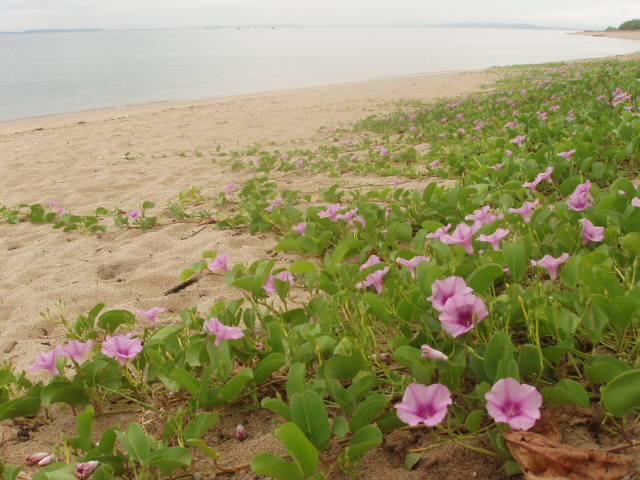
Ragayray is Ipomoea pes-caprae


According to my co-members at the Co's digital Flora of the Philippines FB site, the scientific name of this very familiar crawling vine (ragayray to us in Bulusan) growing lushly and wild near the beaches of Bulusan is Ipomoea pes-caprae.

Though not rare, this plant's botanical name seems to bestow it a sense of a special quality making me looked closely to the minute details-- the color hue of the flower, its veins, the shape of the leaves etcetera. Assigning  formal names gives the plant (for example this common ragayray) a sort of identity for us to take notice and be more mindful of our surroundings including the familiar and the common.

Ordinary flora are commonly taken for granted because of their ordinariness. Familiarity sometimes makes a thing invisible to our sight even though it is right in front of us.

By committing to memory ragayray's formal name, it suddenly becomes extraordinary! The name even sounded like a spell to me while I repeatedly practiced the right way to say it. Ipomoea pes-caprae. Ipomoea pes-caprae. Ipomoea pes-caprae...
Photographs by Alma P. Gamil
Bulusan, Sorsogon, Philippines


Sunday, February 24, 2013

Lake Aguingay in my mind

Lake Aguingay during drier months. Photo credit: Philip G. Bartilet 

Lake Aguingay still showing the receding waters after the rains. Photo credit: Pinoymountaineer.com


Imagine a lake three times the area of Bulusan Lake, her sister lake from the same mountain.

Imagine it on top almost 200 feet higher than her famous sister. Imagine a vast plain when the water receded on drier months. 

Imagine a lake bed like a vast plain savannah. 

Imagine it  surrounded by rainforests. 

Imagine the flora and fauna dancing with the ebb and the tides of these landscapes constantly changing. 

Imagine a lake for all seasons!

Imagine. The marvelous beauty of Lake Aguingay!


Facts:

Lake Aguingay
From Wikipedia, the free encyclopedia
Lake Aguingay
Location               Luzon Island
Coordinates       12°44′57.55″N 124°04′23.04″ECoordinates: 12°44′57.55″N 124°04′23.04″E
Lake type            Seasonal Crater Lake
Basin countries Philippines
Surface area       76 hectares (190 acres)
Shore length1   3.6 kilometres (2.2 mi)
Surface elevation            410 metres (1,350 ft)
1 Shore length is not a well-defined measure.
Lake Aguingay is a vast plain at the center of Bulusan Volcano National Park located near Bulusan Lake at the Municipality of Bulusan, South central part of the Sorsogon Province, Southern Luzon, Bicol Region, Philippines. It is called The Lake because it is occasionally flooded during wet season and dries up during summer. When it is wet it resembles a big lake located right at the foot of Mt. Bulusan. The area is home to various endemic birds, reptiles and other mammals. It is surrounded by lush vegetation and a tropical rain forest. It is only accessible by foot from Bulusan Lake and from the villages of Kapangihan and San Roque


" Bulusan Lake, on the southeastern side of Bulusan Volcano, is 635 meters above sea level.  The lake occupies the depression between two lava flow lobes abutting a hill on the southeast slope of the volcano.  With a depth of 33 meters, the lake covers an area of 16.5 hectares and has a circumference of 2,000 meters.  The intermittent Lake Aguingay is situated at a higher elevation about 1,100 meters above sea level.  This lake appears and disappears depending on the weather condition and even expands to three times the area of Bulusan Lake during extreme rainfall depths."      
Source:The Bicol Regional Physical Framework Plan (RPFP) NEDA 5


Bulusan, Sorsogon, Philippines

Monday, February 18, 2013

Unusual mini iguana in Bulusan


This morning while I was having breakfast of pan de sal and brewed dark barako coffee, Loida, my sister-in-law, excitedly showed me an unusual ‘tabili’ (wild lizard) relative she rescued from their farm. The farm cat made it into a toy and the lizard was almost unconscious from the dragging and toying of the cat at play by the time she came into the rescue. 

At first she taught that it was just an ordinary tabili, she said. But upon closer look the creature reveals some unusual traits.  Very long tail. Green specks on its upper part. Serrated dorsal ridge. Limbs with long set of fingers and claws.


Knowing that I am into photography of the unusual flora and fauna, she wrapped the semi conscious ‘tabili’ relative with a gabi leaf and brought the poor little iguana-like creature for my scrutiny. 

I carefully took the unusual lizard to the top floor azotea to find a place for the fauna. I unwrapped the gabi leaves and lo and behold it was very much alive. It did not jump and run but instead looked at me with steady eyes. Lifting up its head I felt like I am the one being studied. The creature just stood their unmoving giving me the best opportune time to take these photographs.

I am not a lizard expert.  Anybody out there who could identify this lizard will be much appreciated.

After the photo session the unusual lizard jumped over to the kalunggay tree near the railings of our azotea. I whispered my thanks to the little iguana  as it hopped around to the tree branches with its long claws so perfectly adapted for clinging in tree tops while the long tail balances its every movement.


Photographs by Alma P. Gamil
Bulusan, Sorsogon, Philippines

Sunday, February 3, 2013

Pili: Bicol's Heritage Flora


"If forests were not disturbed, this would
have been the safest place to permanently
keep these valuable plant resources."

                    -Roberto E. Coronel, foremost fruit scientist of Asia                
                 

A volunteer Pili tree standing tall along with coconut trees in a farm located in the fringes of Mount Bulusan.
A very strong argument on why the rainforest of Bulusan must be preserved is the definitive scientific paper on Pili authored by Roberto E. Coronel. This study (1996) was made possible by the Institute of Plant Genetics and Crop Plant Research, Gatersleben/International Plant Genetic Resources Institute,Rome, Italy. The study aims to promote the conservation and use of Pili.

Buttressed trunks of Pili trees are most adapted to typhoons. Pili is a resilient plant antedating climate change adaptation.

The stony shell of  the Pili  nut is not a problem in Bulusan. The 'paratilad' or manual de-shellers can retrieve the kernels within seconds by using only a simple bolo.

Part of the study reads:

"Origin and geographic distribution:
The pili is indigenous to the Philippines (Merrill 1912, 1923; Wester 1921; Brown 1954; Li 1970). The crop’s centre of genetic diversity is the Bicol region, possibly in the virgin rainforests surrounding Mt. Bulusan, in the Province of Sorsogon. In the forests of this province, very old pili nut trees measuring more than 50 m in height can still be found today." 

The pulp of the ripe pili  fruits are also source of food  and oil. But the kernels are the most prized.

The planned conversion of the surroundings of Mount Bulusan into a Geothermal Field zone will alter irrevocably the natural habitat chosen by the Pili in its course of evolution that probably took million of years to complete. The species' choice of place is a cocktail mix of many variables : volcanic heat, heavy dose of rainfall, tropical Pacific Ocean, dense rainforest and just being in the right geographical location preferred by the pili.

Pili resin is internationally known as Manila elemi, ingredient for perfumes and pharmaceuticals and  recently for beauty products.
Pili was aptly described  as growing "at the heart of the Pacific Ocean, the island of Luzon..." by an international beauty product ad. The product utilizes the manila elemi, the resin from the pili tree as an ingredient. It highlighted the place of origin of the natural plant resource--the Philippines.

This and many others international recognitions underscore the importance of the Pili as an indigenous plant. And thus, Mount Bulusan being the keeper of the Pili's original genetic pool needs utmost vigilance from the continued threat of 'industrial development' to guarantee that the Pili of the ovatum kind will continue to flourish in perpetuity.

The eminent scientist, Doctor Roberto E. Coronel articulated the following in one of his seminar lectures:

Biodiverslty Conservation Systems
 In Situ Conservation
- All fruits and nuts have evolved as plant
species in the forests.
-If  forests were not disturbed, this would
have been the safest place to permanently
keep these valuable plant resources.


Photos by Alma P. Gamil
Bulusan, Sorsogon


Saturday, January 26, 2013

Pili Diversity in One frame

Few meters away from the border of Bulusan Volcano Natural Park are diverse pili trees (three kinds of pili in this photo alone) noticeably all volunteer growths i.e. planted by wild animals. The photo above looks ordinary in these areas. Canopies of  Canarium ovatum (pili) could be sighted inside and around the BVNP borders corroborating the fact of what was  recorded in the definitive Pili monograph by Roberto E. Coronel, the eminent fruit scientist that Mount Bulusan is probably the center of genetic diversity of Pili.
Prolific Pili tree at the background is the elite kind of pili found in Mount Bulusan.

Zoom in the framed photograph and you will see that the background pili tree (compared with the foreground pili tree) is filled with fruits still green and thus blends with the leaves unnoticed. This kind of prolific pili tree fruiter is the elite variety of pili prized by horticulturists.

I seized the opportunity to ask from the farm owner for a handful of ripe pili nuts (fruits are colored black when ripe) for my potted nursery.

Photo: Taken at the BVNP border by  Alma P. Gamil

Bulusan, Sorsogon, Philippines

Monday, January 21, 2013

Vignettes of Bulusan Rainforest

Leaves line each giant frond.

Tendril like young shoots of giant ferns in Bulusan  rainforest.

A furry bow to everyone who passes by.

 Giant fern leaves form patterns against the sky.

Feather like leaves of giant ferns in Bulusan Volcano Natural Park
Like seducing fingers the young tendrils of giant ferns swirl there and curl here on top of  feather like crown of leaves in different grades of fineness. It provide a soft contrast to the endless entangling of vines in trees and bushes that spread like an amazon wilderness in the vast greenery of Bulusan rainforest. Its edges frame the park's pathway like emerald vignettes.


Photographs by Alma P. Gamil
Bulusan Volcano Natural Park (BVNP), Bulusan, Sorsogon, Philippines


Sunday, January 20, 2013

Acoustic Ecology: The Sound of the Forest

There is a space and time in the zone of the twilight when the last rays of the sun are slowly engulfed by the crawling darkness in the forest when the sound is most intense. It is as if you can feel the collective 'raging against the dying of the light'. It is the sound of the collective sounds of insects from cicada to crickets, bats and some birds species and maybe some nocturnal creatures welcoming the dark. This magical hour is familiar in the rainforest of Mount Bulusan. It is referred to as the 'dusk chorus' in acoustic ecology.

Acoustic ecology is a branch of study for this seemingly unknown aspect of the forest. It is an  area that deals with sound as it relates to the lives of the wildlife living on it:

One specific study is this: insects.oeb.harvard.edu/farrell_lab/undegrads/bseah/lit_review.pdf

It underscores the function of sound as stated at the start of the introduction:

Animals communicate by producing and receiving signals of various kinds, one of them
being sound. A wide variety of animals produce sounds – birds, mammals, amphibians,
arthropods, and even fish. These calls serve various functions, which are mostly
intraspecific: (1) advertisement calls – for males to attract females over long distances,
aids in localization, also involved sometimes in male-male aggression and competition,
(2) aggressive signals – specifically for aggression between competing advertisers, (3)
release calls – especially among anurans, produced by unresponsive individuals when
they are clasped by a male for mating, (4) courtship calls – sometimes also produced by
females, act over a shorter range, produced just prior to mating, (5) distress calls – also
called handling calls, when grasped by predators. (cf. Gerhardt and Huber p.12)


Animals produce acoustic signals for various purposes. Their calls are presumably subject to natural selection. Acoustic ecology is the study of the selective pressures that act upon the calls that animals make.


Thus, to my mind, to alter the acoustic ecology of a pristine area like Mount Bulusan rainforest with the planned introduction of industrial activities of a Geothermal power plant (with noise levels from their industrial operations reaching higher than the decibel range of urban noises) is tantamount to environmental invasion worse than introducing an invasive species of flora and fauna. Its impact to the wildlife residents of the forest is disastrous considering that almost all of these creatures are dependent on sounds for their survival from mating calls to the caring of their youngs.

Note:
For actual sounds of a South East Asian forest in the above mentioned study, this link:  insects.oeb.harvard.edu/farrell_lab/endergrads/bseah_aepf_sounds.html provides a sound gallery (in mp3 format) ranging from sounds of insects such as cicadas and mammals such as bats. The time of the sound recordings differs to get a feel of the actual sound settings. The dawn and dusk chorus for example when the intensity of the sound  of the forest is most pronounced is noted by the study.


Photographs by Alma P. Gamil
Bulusan Volcano Natural Park (BVNP), Bulusan, Sorsogon, Philippines


Saturday, October 27, 2012

Bulusan's Bamban


Bamban plant in Bulusan

Bambam stems are excellent materials for fish trap weaving.

Beginning weave of a fish trap - in Bulusan.

The ASEAN Tropical Plant Database is very specific in its description of the Philippine bamban (Scientific name: Donax cannaeformis (G. Forst.) K Schum.

Fish traps locally called 'bobo' are made from bamban strips from the split stems of this species sustainably harvested by local  fishermen weavers from the nearby farm patches and second growth forests. These bamban (photo) are lushly growing in the hilly part of Barangay Dancalan, Bulusan.

Photographs by Alma P. Gamil
Bulusan, Sorsogon, Philippines


Tuesday, October 2, 2012

Ilóg is the local term for the pili kernels

The recent low pressure area brought slight winds in Bulusan strong enough for some unripe pili fruits to fall off from some pili tree branches in our nearby farm patch in Kapilihan giving us some crispy fresh nuts to munch on.

These kernels are traditionally not use for the confectionery pili sweets. These are not bought by traders too since pili of this kind cannot last for long periods of storage customarily done in the pili trade.

The colors of unripe fruits of the pili ranges from green to greenish purple the locals call 'bulaga'.  The kernels are best eaten raw.

Bulusanons know by heart the taste of these unripe pili kernels. It is part of their childhood memories where once upon a time pili fruit 'hunting' was part of their childhood adventures.

A chef friend described to me the taste of the unriped pili kernels as having a sweet nutty taste with a dill-like flavor.

I have grown dill before in my garden and can honestly say that the description fits exactly.

For pickles' freaks like me, this is the perfect ingredient!

Bulusan, Sorsogon, Philippines

Sunday, September 9, 2012

Kadlum is the high-end Patchouli

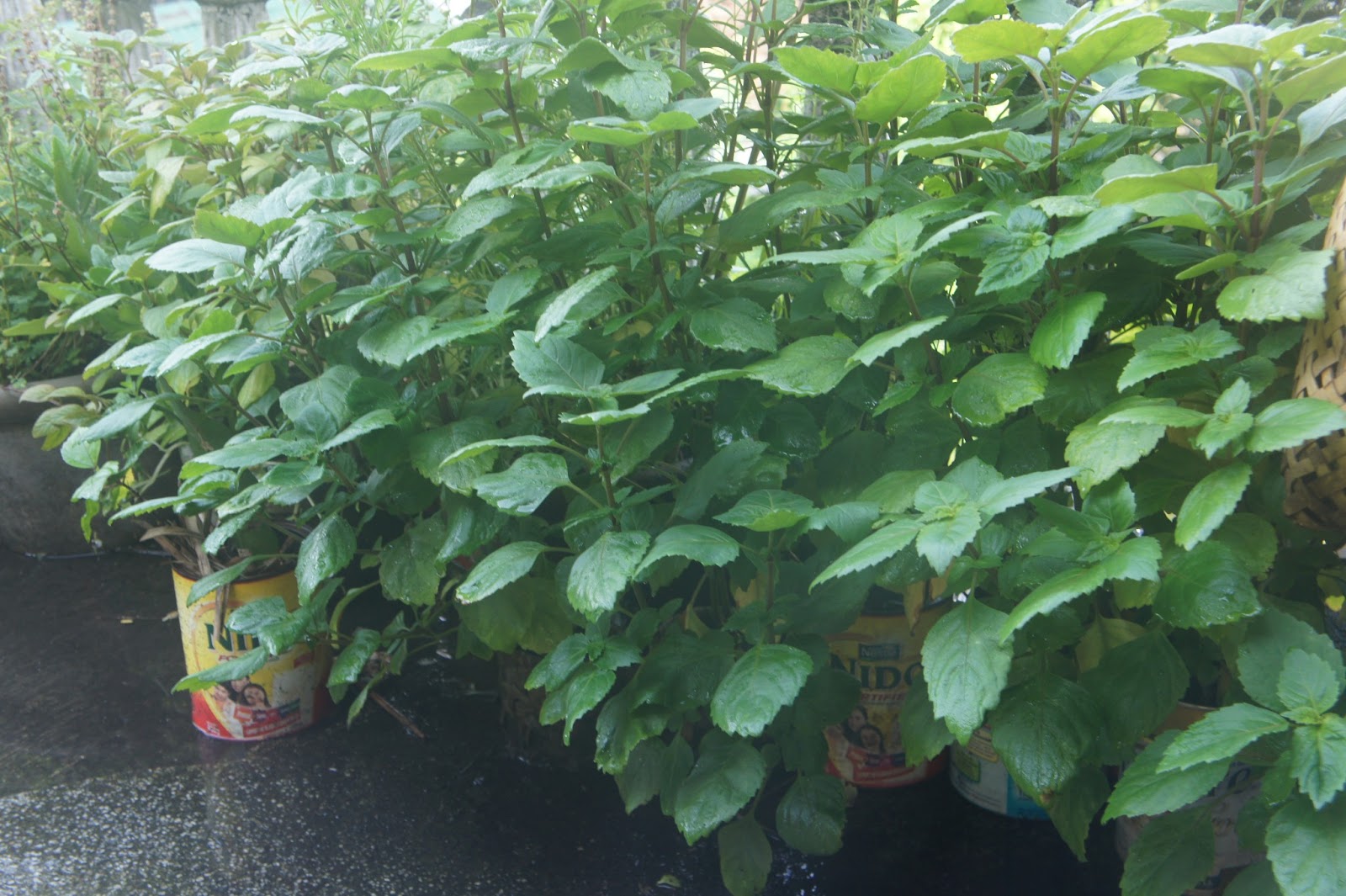
Patchouli locally known as kadlum in Bulusan is lushly growing in my azotea potted garden even with  minimal care.
Patchouli or kadlum are prolific growers. It can even grow in recycled milk tin cans as shown in the above photo of my potted garden in my residence's azotea in Bulusan, Sorsogon.
Kadlum internationally known as patchouli is a popular 'dak'dak' or herbal bath fragrance of Bulusan. Its essential oil is one of the most expensive in the world. It is endemic to the Philippines. However, Indonesia is the leading patchouli producer as listed in leading fragrance journals.

Here are some perfumes with patchouli oil in it: Thierry Mugler Angel, Keiko Mecheri Patchoulissme, Molinard Les Scenteurs Patchouli, Azarro Pour Homme, Balenciaga Homme, Caron French Cancan, Chanel Coco Mademoiselle, Christian Dior Dune, Christian Dior Miss Dior, Clinique Aromatics Elixir, Givenchy Gentleman, Guerlain L'Instant Por Homme, Yves Saint Laurent Kouros and so much more.


A pioneering patchouli oil producer in Sorsogon is currently selling at Php 3,500.00 per liter (farm gate price)for their farm's  locally distilled patchouli oil. 

In the international market, patchouli oil supply was described by the  Market News Service of 2007 as: "supply remains very restricted, demand has been strong, and prices are very high well above the normal long term trading range."

The Lending Model information System for Small-Scale Enterprise in Indonesia shares this information of their patchouli oil industry: Over 80% of Indonesian Patchouli oil is produced in Aceh, North Sumatra and West Sumatra which is mostly exported to industrial countries. Recently, its export-selling price has even reached US$1000/kg in the world market.

It is widely noted in all patchouli literature and references on the net that Pogostemon cablin or locally known as kadlum was bought in from the Philippines to West Sumatra in 1895. It was then cultivated in Aceh and later to Central Java.

Surprisingly, the Philippines to date has no patchouli oil industry, the same with the other essential oils from plants originating from the Philippines. The country's essential oil industry is in fact  tagged as a neglected industry despite its market potential and the available native plant resources.


Tuesday, September 4, 2012

Bulusan Lake unknown fact

Bulusan Lake though the toast of the recent eco-tourism promotions of the province, second only to Donsol is virtually unstudied according to a Rapid Assessment Report conducted by an NGO. The flora and fauna around it are also understudied the report added. The endemism of the place is high though at more than 40% as cited in the report.

The report by Errol Gatumbato in his personal blog reads:

Together with four other hired specialists of the Resources, Environment and Economics Center for Studies, we conducted a rapid site assessment to this protected area commissioned by the Foundation for the Philippine Environment. The assessment involved the physical, biological, social, cultural, economics, and governance conditions of the BVNP.

The remaining forest of the BVNP is hosting to numerous species of flora and fauna while the freshwater ecosystem is hardly studied*

Our study showed that the forest in this protected area is an important habitat of numerous endemic species of plants, such as the Forestia philippinensis, Pinanga insignis, Areca camarinensis, Mussaenda phillipica and two newly discovered species, Schefflina bulusanicum and Pronephrium bulusanicum.  Rare and threatened species can also be found in BVNP, such as the Jade vine (Strongylodon macrobotrys), the ground orchid (Phojus tankervillea), and Tindalo (Afzelia rhomboidea).  The mountain agoho (Casuarina rumphiana), which is known to have a very limited distribution in the Philippines and Southeast Asia, inhabits this protected area.
Similarly, the fauna features of the BVNP are showing high species endemism, estimated at 43% of all the species surveyed during the RSA.  Four of these species are known as high conservation priorities because they are already classified as threatened species, like the Golden-crowned flying fox (Acerodon jubatos), the Southern Luzon giant cloud rat (Phloeomys cumingii), the Philippine warty pig (Sus philippensis) and the Luzon Tarictic hornbill (Penelopides manillae).

Errol's complete story:

Bulusan Park, the “little Switzerland” of Bicol « Errol Abada Gatumbato

errolgatumbato.wordpress.com/.../bulusan-park-the-little-switz.

Monday, July 9, 2012

Engkantada: Bulusan's Mystery Flower


Engkantada is as luminous as the high rise of the full moon. Her ethereal beauty is visible only to a night stalker--me.

I knew beforehand that it will be a one-night performance only for this ephemeral beauty. So, I have to be patient in the waiting game. Then the final hour, the flower reveals herself which is a cross between a lotus and an orchid. What a mesmerizing sight! An apparition in her whiteness. Her scent was the most subtle kind of sweetness unlike any other fragrance.

Photos: Alma P. Gamil
Bulusan, Sorsogon, Philippines