Showing posts with label Bulusan flora. Show all posts

Sunday, May 26, 2013

Agoho and Bulusan Volcano


"The mountain agoho (Casuarina rumphiana), which is known to have a very limited distribution in the Philippines and Southeast Asia, inhabits this protected area," reads part of the assessment report re BVNP of the team of Errol Gatumbato a noted environmentalist in the Philippines.  By protected area, this refers to  BVNP, Bulusan Volcano Natural Park located in the composite mountains of Bulusan Volcano (above and below photos). 
Some of these trees found its way in the lower areas of Bulusan comprising the residential areas. I have seen one big agoho at the churchyard and several at the cottage  grounds of Dancalan beach where this photo was taken.  The dangling leaves that fringe the upper  frame of the above photo are from an old agoho tree standing beside the open cottages in Dancalan beach. The electric wires along the road  run across the photo from this vantage point.

Bulusan Volcano (composite mountains) as it appears on a cloudless day, May 26, 2013.
Photos: Alma P. Gamil
Bulusan, Sorsogon, Philippines

Thursday, April 18, 2013

Kamandiis: Philippine endemic still growing wild in Bulusan


My recent visit to Odikin was rewarded with a chance encounter with another endemic Philippine tree, Kamandiis, growing wild along the mountain road.

The small-built tree looks more compact and charming in situ. I will love this growing in my backyard (if I have my own) for this reason alone. The flowers that seem to be always in the bud stage are the color of delicious berries arranged spatially in the twigs in random order. It is the kind of twig that will look excellent in a flower vase arrangement ikebana style.

But the most interesting trait of Kamandiis  in addition to its look is the taste. Not the fruit because at this time it is still in the flowering stage but the leaves and the flowers! I chewed one small leaf just to test if it tasted really sour or tart as related by Oya Choleng, my village guide. The taste is sour alright but not the kind of acidity that the Lubas leaf (another native) offers.

The fruit is used as souring agent for some local cooking recipes and a rich source of natural vitamin C. It gives added tartness to stewed fishes and vegetables in lieu of vinegar according to Oya Choleng, a village native.

Highlighted photo to emphasize the flower buds attached close to the twigs and branches. At this month of the year, the Kamandiis is profused with  minute red flowers.

The ASEAN Tropical Plant database classified Kamandiis as a Philippine endemic. Taxonomic record from the data base is as follows:
Scientific nameGarcinia rubra Merr.
Family nameClusiaceae
Kamandiis minute flower buds
Reminder: "If forests were not disturbed, this would have been the safest place to permanently keep these valuable plant resources." ~ Roberto E. Coronel, foremost fruit scientist of Asia

Photos by Alma P. Gamil
Santa Barbara (Odikin), Bulusan, Sorsogon


Saturday, January 26, 2013

Pili Diversity in One frame

Few meters away from the border of Bulusan Volcano Natural Park are diverse pili trees (three kinds of pili in this photo alone) noticeably all volunteer growths i.e. planted by wild animals. The photo above looks ordinary in these areas. Canopies of  Canarium ovatum (pili) could be sighted inside and around the BVNP borders corroborating the fact of what was  recorded in the definitive Pili monograph by Roberto E. Coronel, the eminent fruit scientist that Mount Bulusan is probably the center of genetic diversity of Pili.
Prolific Pili tree at the background is the elite kind of pili found in Mount Bulusan.

Zoom in the framed photograph and you will see that the background pili tree (compared with the foreground pili tree) is filled with fruits still green and thus blends with the leaves unnoticed. This kind of prolific pili tree fruiter is the elite variety of pili prized by horticulturists.

I seized the opportunity to ask from the farm owner for a handful of ripe pili nuts (fruits are colored black when ripe) for my potted nursery.

Photo: Taken at the BVNP border by  Alma P. Gamil

Bulusan, Sorsogon, Philippines

Saturday, October 27, 2012

Bulusan's Bamban


Bamban plant in Bulusan

Bambam stems are excellent materials for fish trap weaving.

Beginning weave of a fish trap - in Bulusan.

The ASEAN Tropical Plant Database is very specific in its description of the Philippine bamban (Scientific name: Donax cannaeformis (G. Forst.) K Schum.

Fish traps locally called 'bobo' are made from bamban strips from the split stems of this species sustainably harvested by local  fishermen weavers from the nearby farm patches and second growth forests. These bamban (photo) are lushly growing in the hilly part of Barangay Dancalan, Bulusan.

Photographs by Alma P. Gamil
Bulusan, Sorsogon, Philippines


Tuesday, October 2, 2012

Ilóg is the local term for the pili kernels

The recent low pressure area brought slight winds in Bulusan strong enough for some unripe pili fruits to fall off from some pili tree branches in our nearby farm patch in Kapilihan giving us some crispy fresh nuts to munch on.

These kernels are traditionally not use for the confectionery pili sweets. These are not bought by traders too since pili of this kind cannot last for long periods of storage customarily done in the pili trade.

The colors of unripe fruits of the pili ranges from green to greenish purple the locals call 'bulaga'.  The kernels are best eaten raw.

Bulusanons know by heart the taste of these unripe pili kernels. It is part of their childhood memories where once upon a time pili fruit 'hunting' was part of their childhood adventures.

A chef friend described to me the taste of the unriped pili kernels as having a sweet nutty taste with a dill-like flavor.

I have grown dill before in my garden and can honestly say that the description fits exactly.

For pickles' freaks like me, this is the perfect ingredient!

Bulusan, Sorsogon, Philippines

Sunday, September 9, 2012

Kadlum is the high-end Patchouli

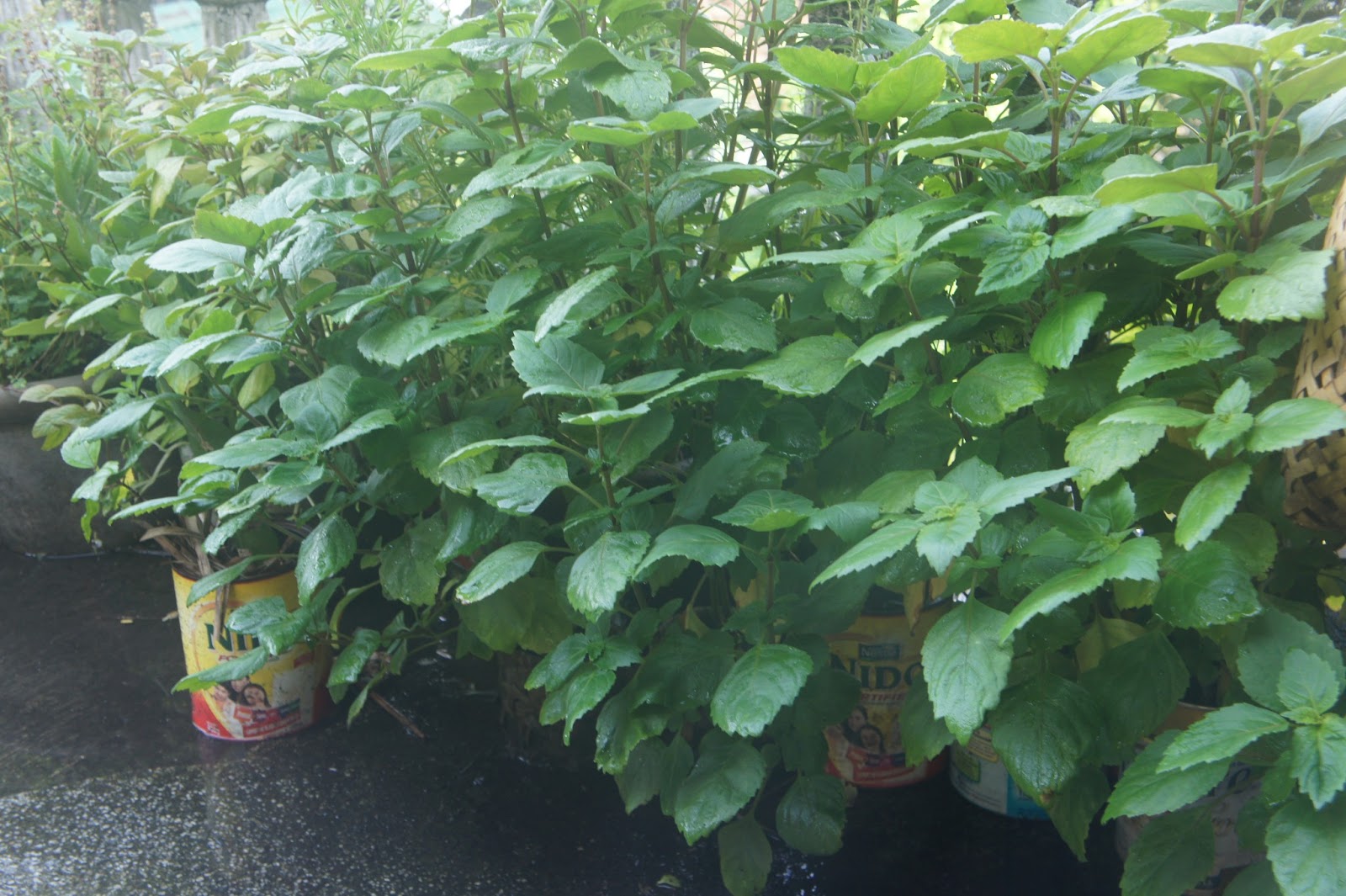
Patchouli locally known as kadlum in Bulusan is lushly growing in my azotea potted garden even with  minimal care.
Patchouli or kadlum are prolific growers. It can even grow in recycled milk tin cans as shown in the above photo of my potted garden in my residence's azotea in Bulusan, Sorsogon.
Kadlum internationally known as patchouli is a popular 'dak'dak' or herbal bath fragrance of Bulusan. Its essential oil is one of the most expensive in the world. It is endemic to the Philippines. However, Indonesia is the leading patchouli producer as listed in leading fragrance journals.

Here are some perfumes with patchouli oil in it: Thierry Mugler Angel, Keiko Mecheri Patchoulissme, Molinard Les Scenteurs Patchouli, Azarro Pour Homme, Balenciaga Homme, Caron French Cancan, Chanel Coco Mademoiselle, Christian Dior Dune, Christian Dior Miss Dior, Clinique Aromatics Elixir, Givenchy Gentleman, Guerlain L'Instant Por Homme, Yves Saint Laurent Kouros and so much more.


A pioneering patchouli oil producer in Sorsogon is currently selling at Php 3,500.00 per liter (farm gate price)for their farm's  locally distilled patchouli oil. 

In the international market, patchouli oil supply was described by the  Market News Service of 2007 as: "supply remains very restricted, demand has been strong, and prices are very high well above the normal long term trading range."

The Lending Model information System for Small-Scale Enterprise in Indonesia shares this information of their patchouli oil industry: Over 80% of Indonesian Patchouli oil is produced in Aceh, North Sumatra and West Sumatra which is mostly exported to industrial countries. Recently, its export-selling price has even reached US$1000/kg in the world market.

It is widely noted in all patchouli literature and references on the net that Pogostemon cablin or locally known as kadlum was bought in from the Philippines to West Sumatra in 1895. It was then cultivated in Aceh and later to Central Java.

Surprisingly, the Philippines to date has no patchouli oil industry, the same with the other essential oils from plants originating from the Philippines. The country's essential oil industry is in fact  tagged as a neglected industry despite its market potential and the available native plant resources.


Monday, July 9, 2012

Engkantada: Bulusan's Mystery Flower


Engkantada is as luminous as the high rise of the full moon. Her ethereal beauty is visible only to a night stalker--me.

I knew beforehand that it will be a one-night performance only for this ephemeral beauty. So, I have to be patient in the waiting game. Then the final hour, the flower reveals herself which is a cross between a lotus and an orchid. What a mesmerizing sight! An apparition in her whiteness. Her scent was the most subtle kind of sweetness unlike any other fragrance.

Photos: Alma P. Gamil
Bulusan, Sorsogon, Philippines