Showing posts with label Bicol. Show all posts

Sunday, November 25, 2012

Tangkwa: Philippine native gourd in Bulusan's heritage recipe

Tangkwa from my garden temporarily functions as a living room accent while waiting for my non-busy days to turn the gourd into a dessert using a Bulusan recipe with pili and lemon de china.


The local "tangkwa" is a fruit in the gourd family (Cucurbitaceae family), a herbaceous tendril-bearing vine that includes the cucumber, melon, squash, and pumpkin.

Grown in the backyard garden of rural homes in the Philippines including Bulusan it is the main ingredient in a local dessert with pili nuts in marmalade-sugar mix accented by lemon de china.

This recipe can be considered a heritage recipe in this noted pili-riched town for this used to be a regular and popular dessert during fiestas in Bulusan. However this is seldom prepared now. The fruit brings memories of Lola Ingga and Lola Datay serving their guests with this well-loved 'dulsi na tangkwa' in my father's ancestral home in Poblacion Sabang in Bulusan.

Detailed instructions of this Bulusan heritage recipe of  Dulsi na Tangkwa (Sweetened Tangkwa) is documented excellently in a  Bulusanon web site :pamughaton.net


Bulusan, Sorsogon, Philippines

Thursday, November 15, 2012

Tuob as Indigenous Knowledge: Aligning with the Elements of Nature

As an apprentice for the bobo maker I listened to every word he says. After the weaving sessions that took around several days of 'chop-chop' (segmented) demonstration of  'bobo' weaving steps, Inggo, explained that the process of integrating the object to the sea has in fact not yet commenced.

"This is my old bobo and this one (lifting the other bobo)is the newly woven one. I cannot just immerse this new bobo fish trap into the sea. I have to follow my accustomed rituals as taught to me by an old parabolong (medicine man cum village shaman).


The same items used for the traditional tuob as commonly practiced, the 'kamanyang', 'oliva' palm leaves from the recent 'hosana' are to be utilized in the tuob ritual. The additional material and the most important in this particular tuob specifically done for my bobo fish traps are the pieces of pandan leaves gathered near the shore as the final ingredient in the 'tuob' explained Inggo. The numbers must be in the odd number never in the even. 3, 5 and 7 are odd numbers.

Tuob is a ritual of cleansing and blessing at the same time. It bestows the object a sense of invulnerability to bad luck and to shoo away unfriendly spirits that will cause it to not function properly in the tasks ahead. It aligns it to the good elements of nature and attracts the good chi and thus more fishes will lend itself to be caught in it. This is in sum the purpose of the ritual the way I understood  Inggo.

"I prepare these items when everyone is asleep and I see to it that there are no people in my route to the sea so as the remaining embers of  the tuob materials will be able to float freely to the sea unencumbered free from the prying eyes of curious onlookers. In a 'bagol' (half coconut shell) the materials are earlier made into a fire to produce the thick smoke so important for the tuob process. The smoke must bathe the newly woven bobo fish trap entirely for several minutes.

After the ritual, the remaining embers are brought to sea as quickly and secretly as possible to be floated unto the vast unending sea inside the same 'bagol' used in the tuob.. This I believe is a symbolic act that pays homage to the spirits of the sea.

"One must not look back after the tuob's remaining glowing fragment is set to float to the sea. You must go back as quickly as possible leaving the embers in the half coconut shell floating to the vastness of the ocean with its remaining smoke finally extinguished by the ocean breeze."


Bulusan, Sorsogon, Philippines

Wednesday, November 14, 2012

Optical Phenomena in Magical Mount Bulusan

Photo: realrica.com


Spectacular solar optic effects at the gaping mouth of Bulusan Volcano! Marvelous nature show.

A fog bow, solar glory, Brocken Spectre 3-in-1 phenomena caught in this one of a kind photograph by the team of Pinoy mountaineers with celebrity climber Ms Rica Peralejo last June 24 of this year.

These are actually three distinct phenomena : The fog bow appears here as a 360 degree white rainbow. The solar glory is a band of colored rings at the inner rim surrounding the shadowy  figure technically known as the Brocken Spectre at the center.

This seemingly supernatural optical phenomenon is rare. One must be at the right location at the right time with the right conditions to produce this atmospheric optical effects. The mountaineers were a lucky bunch to be present on the right spot at the right moment when the crater center was at the perfect moment for this nature spectacle to happen.

The mist of fog or cloud is needed to be at the center of the crater first and foremost. This will serve as the ‘screen’  (as in a movie) for the shadow of the observer standing near the rim of the crater. The sun must be at the back  just like a projector to the observer in whose shadow will be then projected at the thick fog located exactly at the mouth of the volcano.

The effect is optical magic. A marvelous  nature show. Colored rings known as solar glory appears around the head of the Brocken Spectre not unlike colored band of halos. It surely looks like a spiritual apparition for those not familiar with this rare nature phenomenon.

Adding up to the magic is the white rainbow commonly referred to as the fog bow forming the larger circumference--a  giant circular host-like apparition. It is as if the volcano’s crater is about to swallow a gigantic host from heaven.
Solar glories are formed by diffraction where light waves are scattered into a ring-like pattern as differentiated to a regular rainbow that usually appears as a colored arc in the sky which is formed by refraction and reflection. In this photo the glory forms inside the inner rings just above the head of the Brocken  Spectre. 

Do not be alarmed. The Brocken Specter is not a dark ghostly apparition. It is merely an elongated shadow casts into the clouds--the shadow of the observer and most of the time --the photographer/climber. The clouds and fog sort of distort the human shadow as it moves.

The anti-solar point is the exact spot where the solar glory and the Brocken Spectre appear. It is directly opposite the sun from the observer’s perspective.

This atmospheric spectacle is the first time ever recorded inside the crater of  Bulusan Volcano—probably  the only one of its kind in the world.

Written by: Alma P. Gamil
Bulusan, Sorsogon, Philippines

Friday, November 9, 2012

Magical Mount Bulusan: Ms Rica and the white rainbow

Magical Mount Bulusan. This is not a cliche. This is real.

I saw the magic unravel in the photos of Rica Peralejo-Bonifacio and her fellow trekkers.

They might not know it but they have stumbled upon a very rare phenomenon known as a fog bow during their recent trek to Mount Bulusan.

A fog bow is a 'white rainbow'. White because the colors are so faint it appear whitish. Almost ghostly. But yes the colors are there. And to add to the magic: the white rainbow appeared in a 360 degree form-- meaning a circle. The gaping crater of  Bulusan Volcano appears like in the act of swallowing a  giant Holy host from heaven.

They always say that there is a pot of gold at the end of the rainbow. But this one is not the end of the rainbow (as the photo shows). This one is right at the HEART of a rainbow with the faintest colors of pink, yellow and blue.

More than a pot of gold I am sure is in there-- though not literally.

Whereas a rainbow is the result of the optical effects caused by  droplets of rain meeting the rays of the sun at a specific angle (42 degrees according to scientific journals), the fog bow on the other hand is caused by a mist of fog smaller than rain droplets not strong enough to reflect and refract colors vivid enough to the eyes. Thus a whitish arc or in this case a circle is formed instead.

The sight is truly magical and almost spiritual. It looks like an apparition of nature.

I have checked the web for similar photos of a crater with a white rainbow but none so far yielded to my virtual search. Arctic white rainbow. Yes, sighted by an expedition team. Golden Gate Bridge white rainbow. Yes, as captured by a photographer. But not this kind of a gaping mouth of a volcano with a giant 'host', the Eucharistic bread from heaven in a suspended  freeze frame waiting to be swallowed by the magnificent Bulusan Volcano from the hands of the  holy sky.

To the trekkers and to the beautiful Ms. Rica Peralejo-Bonifacio:

All I can say is: wish I was there!         (Photos: realrica.com)
http://realrica.com/blog/wp-content/uploads/2012/06/GOPR0260.jpg
For the complete set of photos from Ms Rica Peralejo Bonifacio with the white rainbow: realrica.com

http://realrica.com/blog/wp-content/uploads/2012/06/GOPR0260.jpg

Friday, November 2, 2012

All Saints' Day Photography 101 in Bulusan

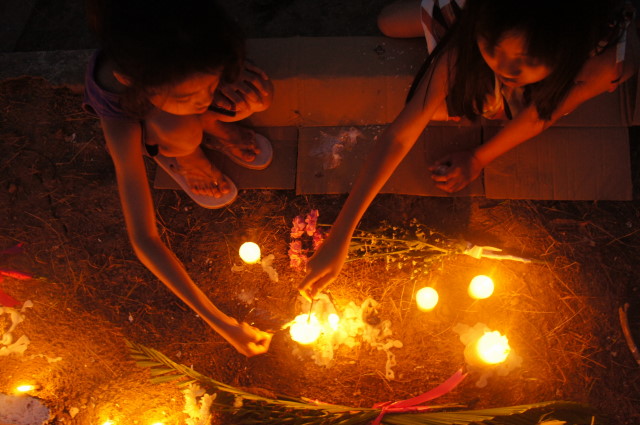
The cemetery never fails to yield dramatic photographs. This is true whether in its ordinary desolate days and during All Saints' Day and All Souls' Day celebrated November 1 and 2 when the cemetery is full of life.


For those living in the city a trip back home during these days to visit their loved ones (both the living and the dead) are customary. And the visit to the cemetery is the highlight of the trip.

But for some young ones who tugged along with their moms and dads this can be a boring activity. So a little creativity is needed to inject interest to my nieces for the obligatory visit.

My teenage niece Ging dubbed it as Photography 101, Subject: Todos Los Santos in Bulusan. The younger ones Yapa and cousin Angie acted as the models. Me and Ging as the photographers.

The above photos were some of the captured scenes.


Bulusan, Sorsogon, Philippines


Monday, October 29, 2012

Blog about a tourist blog of my hometown Bulusan

Reading the blog of islandgirltraveller.com was a relief from the usual destinations themed blog about my hometown. This blog is about the daily routine of the common folks as she sees it in situ. The pictures were taken from the market, in the streets, common folks doing their daily routine. She captured it as is.

I just hope she was able to visit the usual tourist route and the less known sites too. Because the slow-paced quiet town as she sees it is in fact a keeper of magnificent grand sights such as the volcanic landscapes of Mount Bulusan, the coral-rimmed beaches along her shores, mountain springs  with soda like waters, gushing water falls, moist and foggy rainforest with a lot of surprises, zen like calmness of an emerald lake and so much more.

Thanks for the visit Ms islandgirltraveller.

(You may want to visit islandgirltraveller.com blog entitled The Quiet Town of Bulusan, Sorsogon for her story about my hometown).


Bulusan, Sorsogon, Philippines

Saturday, October 27, 2012

Bulusan's Bamban


Bamban plant in Bulusan

Bambam stems are excellent materials for fish trap weaving.

Beginning weave of a fish trap - in Bulusan.

The ASEAN Tropical Plant Database is very specific in its description of the Philippine bamban (Scientific name: Donax cannaeformis (G. Forst.) K Schum.

Fish traps locally called 'bobo' are made from bamban strips from the split stems of this species sustainably harvested by local  fishermen weavers from the nearby farm patches and second growth forests. These bamban (photo) are lushly growing in the hilly part of Barangay Dancalan, Bulusan.

Photographs by Alma P. Gamil
Bulusan, Sorsogon, Philippines


Tuesday, October 2, 2012

Ilóg is the local term for the pili kernels

The recent low pressure area brought slight winds in Bulusan strong enough for some unripe pili fruits to fall off from some pili tree branches in our nearby farm patch in Kapilihan giving us some crispy fresh nuts to munch on.

These kernels are traditionally not use for the confectionery pili sweets. These are not bought by traders too since pili of this kind cannot last for long periods of storage customarily done in the pili trade.

The colors of unripe fruits of the pili ranges from green to greenish purple the locals call 'bulaga'.  The kernels are best eaten raw.

Bulusanons know by heart the taste of these unripe pili kernels. It is part of their childhood memories where once upon a time pili fruit 'hunting' was part of their childhood adventures.

A chef friend described to me the taste of the unriped pili kernels as having a sweet nutty taste with a dill-like flavor.

I have grown dill before in my garden and can honestly say that the description fits exactly.

For pickles' freaks like me, this is the perfect ingredient!

Bulusan, Sorsogon, Philippines

Sunday, September 9, 2012

Kadlum is the high-end Patchouli

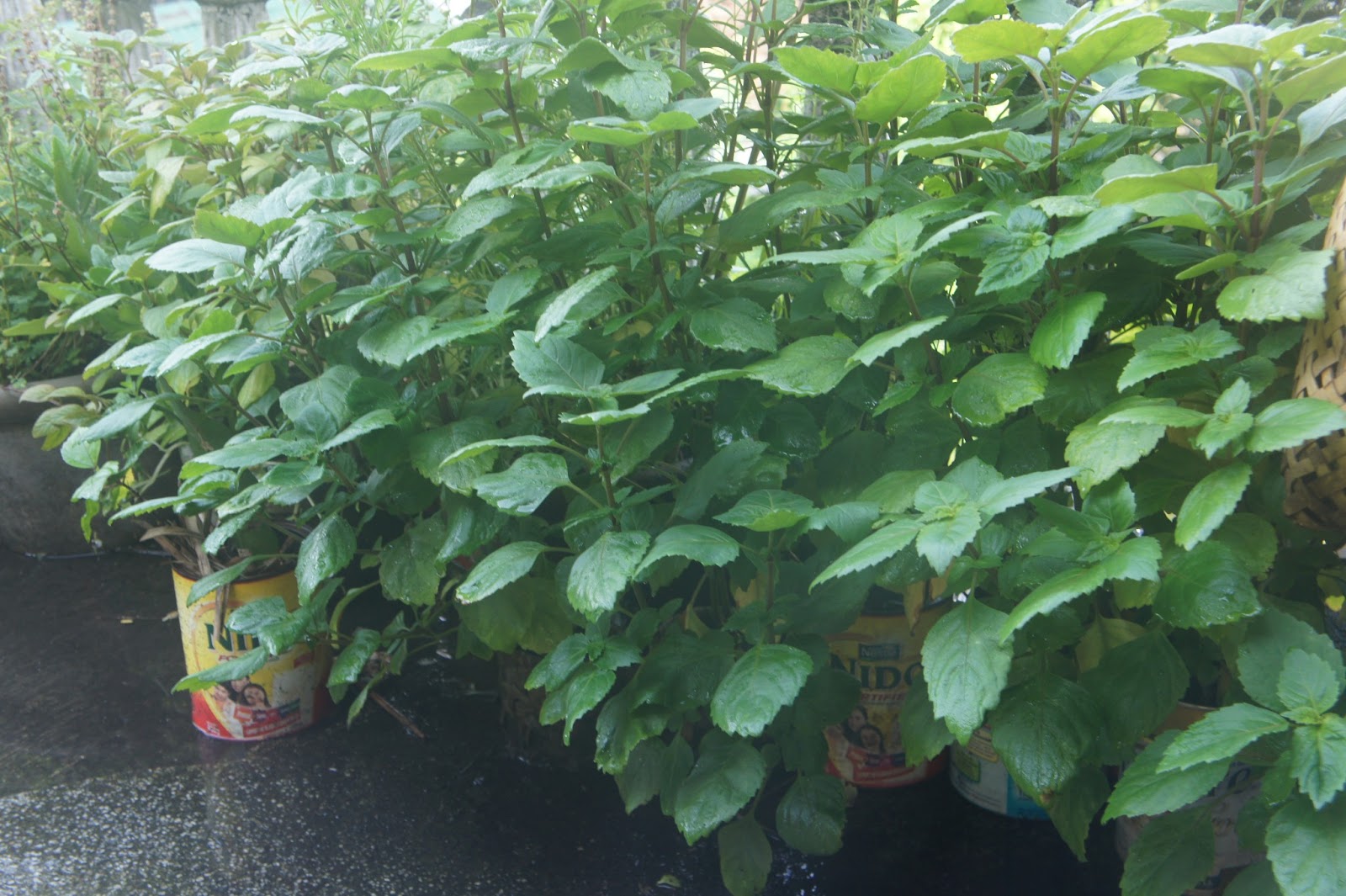
Patchouli locally known as kadlum in Bulusan is lushly growing in my azotea potted garden even with  minimal care.
Patchouli or kadlum are prolific growers. It can even grow in recycled milk tin cans as shown in the above photo of my potted garden in my residence's azotea in Bulusan, Sorsogon.
Kadlum internationally known as patchouli is a popular 'dak'dak' or herbal bath fragrance of Bulusan. Its essential oil is one of the most expensive in the world. It is endemic to the Philippines. However, Indonesia is the leading patchouli producer as listed in leading fragrance journals.

Here are some perfumes with patchouli oil in it: Thierry Mugler Angel, Keiko Mecheri Patchoulissme, Molinard Les Scenteurs Patchouli, Azarro Pour Homme, Balenciaga Homme, Caron French Cancan, Chanel Coco Mademoiselle, Christian Dior Dune, Christian Dior Miss Dior, Clinique Aromatics Elixir, Givenchy Gentleman, Guerlain L'Instant Por Homme, Yves Saint Laurent Kouros and so much more.


A pioneering patchouli oil producer in Sorsogon is currently selling at Php 3,500.00 per liter (farm gate price)for their farm's  locally distilled patchouli oil. 

In the international market, patchouli oil supply was described by the  Market News Service of 2007 as: "supply remains very restricted, demand has been strong, and prices are very high well above the normal long term trading range."

The Lending Model information System for Small-Scale Enterprise in Indonesia shares this information of their patchouli oil industry: Over 80% of Indonesian Patchouli oil is produced in Aceh, North Sumatra and West Sumatra which is mostly exported to industrial countries. Recently, its export-selling price has even reached US$1000/kg in the world market.

It is widely noted in all patchouli literature and references on the net that Pogostemon cablin or locally known as kadlum was bought in from the Philippines to West Sumatra in 1895. It was then cultivated in Aceh and later to Central Java.

Surprisingly, the Philippines to date has no patchouli oil industry, the same with the other essential oils from plants originating from the Philippines. The country's essential oil industry is in fact  tagged as a neglected industry despite its market potential and the available native plant resources.


Tuesday, September 4, 2012

Bulusan Lake unknown fact

Bulusan Lake though the toast of the recent eco-tourism promotions of the province, second only to Donsol is virtually unstudied according to a Rapid Assessment Report conducted by an NGO. The flora and fauna around it are also understudied the report added. The endemism of the place is high though at more than 40% as cited in the report.

The report by Errol Gatumbato in his personal blog reads:

Together with four other hired specialists of the Resources, Environment and Economics Center for Studies, we conducted a rapid site assessment to this protected area commissioned by the Foundation for the Philippine Environment. The assessment involved the physical, biological, social, cultural, economics, and governance conditions of the BVNP.

The remaining forest of the BVNP is hosting to numerous species of flora and fauna while the freshwater ecosystem is hardly studied*

Our study showed that the forest in this protected area is an important habitat of numerous endemic species of plants, such as the Forestia philippinensis, Pinanga insignis, Areca camarinensis, Mussaenda phillipica and two newly discovered species, Schefflina bulusanicum and Pronephrium bulusanicum.  Rare and threatened species can also be found in BVNP, such as the Jade vine (Strongylodon macrobotrys), the ground orchid (Phojus tankervillea), and Tindalo (Afzelia rhomboidea).  The mountain agoho (Casuarina rumphiana), which is known to have a very limited distribution in the Philippines and Southeast Asia, inhabits this protected area.
Similarly, the fauna features of the BVNP are showing high species endemism, estimated at 43% of all the species surveyed during the RSA.  Four of these species are known as high conservation priorities because they are already classified as threatened species, like the Golden-crowned flying fox (Acerodon jubatos), the Southern Luzon giant cloud rat (Phloeomys cumingii), the Philippine warty pig (Sus philippensis) and the Luzon Tarictic hornbill (Penelopides manillae).

Errol's complete story:

Bulusan Park, the “little Switzerland” of Bicol « Errol Abada Gatumbato

errolgatumbato.wordpress.com/.../bulusan-park-the-little-switz.