Showing posts with label flora and fauna. Show all posts

Tuesday, March 19, 2013

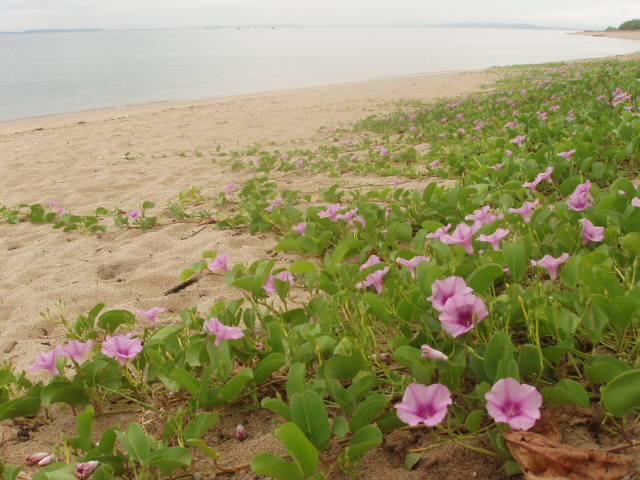
Ragayray is Ipomoea pes-caprae


According to my co-members at the Co's digital Flora of the Philippines FB site, the scientific name of this very familiar crawling vine (ragayray to us in Bulusan) growing lushly and wild near the beaches of Bulusan is Ipomoea pes-caprae.

Though not rare, this plant's botanical name seems to bestow it a sense of a special quality making me looked closely to the minute details-- the color hue of the flower, its veins, the shape of the leaves etcetera. Assigning  formal names gives the plant (for example this common ragayray) a sort of identity for us to take notice and be more mindful of our surroundings including the familiar and the common.

Ordinary flora are commonly taken for granted because of their ordinariness. Familiarity sometimes makes a thing invisible to our sight even though it is right in front of us.

By committing to memory ragayray's formal name, it suddenly becomes extraordinary! The name even sounded like a spell to me while I repeatedly practiced the right way to say it. Ipomoea pes-caprae. Ipomoea pes-caprae. Ipomoea pes-caprae...

Photographs by Alma P. Gamil
Bulusan, Sorsogon, Philippines


Thursday, March 14, 2013

Finding Merton one slow afternoon in Bulusan


For, like a grain of fire
Smouldering in the heart of every living essence
God plants His undivided power –
Buries His thought too vast for worlds
In seed and root and blade and flower,


The Sowing of Meanings
by Thomas Merton

See the high birds! Is their’s the song
That dies among the wood-light
Wounding the listener with such bright arrows?
Or do they play in wheeling silences
Defining in the perfect sky
The bounds of (here below) our solitude,

Where spring has generated lights of green
To glow in clouds upon the sombre branches?
Ponds full of sky and stillnesses
What heavy summer songs still sleep
Under the tawny rushes at your brim?

More than a season will be born here, nature,
In your world of gravid mirrors!
The quiet air awaits one note,
One light, one ray and it will be the angels’ spring:
One flash, one glance upon the shiny pond, and then
Asperges me! sweet wilderness, and lo! we are redeemed!

For, like a grain of fire
Smouldering in the heart of every living essence
God plants His undivided power –
Buries His thought too vast for worlds
In seed and root and blade and flower,

Until, in the amazing light of April,
Surcharging the religious silence of the spring,
Creation finds the pressure of His everlasting secret
Too terrible to bear.

Then every way we look, lo! rocks and trees
Pastures and hills and streams and birds and firmament
And our own souls within us flash, and shower us with light,
While the wild countryside, unknown, unvisited of men,
Bears sheaves of clean, transforming fire.

And then, oh then the written image, schooled in sacrifice,
The deep united threeness printed in our being,
Shot by the brilliant syllable of such an intuition, turns within,
And plants that light far down into the heart of darkness and oblivion,
Dives after, and discovers flame.

  — from Selected Poems of Thomas Merton, by Thomas Merton

Photo from http://pamughaton.wordpress.com/2010/05/20/tag-sudang/ Camia is a local flower with a fragrance that is most exquisite. A perfect subtle kind of sweetness. It thrives abundantly in Bulusan.

Bulusan, Sorsogon, Philippines

Monday, February 18, 2013

Unusual mini iguana in Bulusan


This morning while I was having breakfast of pan de sal and brewed dark barako coffee, Loida, my sister-in-law, excitedly showed me an unusual ‘tabili’ (wild lizard) relative she rescued from their farm. The farm cat made it into a toy and the lizard was almost unconscious from the dragging and toying of the cat at play by the time she came into the rescue. 

At first she taught that it was just an ordinary tabili, she said. But upon closer look the creature reveals some unusual traits.  Very long tail. Green specks on its upper part. Serrated dorsal ridge. Limbs with long set of fingers and claws.


Knowing that I am into photography of the unusual flora and fauna, she wrapped the semi conscious ‘tabili’ relative with a gabi leaf and brought the poor little iguana-like creature for my scrutiny. 

I carefully took the unusual lizard to the top floor azotea to find a place for the fauna. I unwrapped the gabi leaves and lo and behold it was very much alive. It did not jump and run but instead looked at me with steady eyes. Lifting up its head I felt like I am the one being studied. The creature just stood their unmoving giving me the best opportune time to take these photographs.

I am not a lizard expert.  Anybody out there who could identify this lizard will be much appreciated.

After the photo session the unusual lizard jumped over to the kalunggay tree near the railings of our azotea. I whispered my thanks to the little iguana  as it hopped around to the tree branches with its long claws so perfectly adapted for clinging in tree tops while the long tail balances its every movement.


Photographs by Alma P. Gamil
Bulusan, Sorsogon, Philippines

Tuesday, September 4, 2012

Bulusan Lake unknown fact

Bulusan Lake though the toast of the recent eco-tourism promotions of the province, second only to Donsol is virtually unstudied according to a Rapid Assessment Report conducted by an NGO. The flora and fauna around it are also understudied the report added. The endemism of the place is high though at more than 40% as cited in the report.

The report by Errol Gatumbato in his personal blog reads:

Together with four other hired specialists of the Resources, Environment and Economics Center for Studies, we conducted a rapid site assessment to this protected area commissioned by the Foundation for the Philippine Environment. The assessment involved the physical, biological, social, cultural, economics, and governance conditions of the BVNP.

The remaining forest of the BVNP is hosting to numerous species of flora and fauna while the freshwater ecosystem is hardly studied*

Our study showed that the forest in this protected area is an important habitat of numerous endemic species of plants, such as the Forestia philippinensis, Pinanga insignis, Areca camarinensis, Mussaenda phillipica and two newly discovered species, Schefflina bulusanicum and Pronephrium bulusanicum.  Rare and threatened species can also be found in BVNP, such as the Jade vine (Strongylodon macrobotrys), the ground orchid (Phojus tankervillea), and Tindalo (Afzelia rhomboidea).  The mountain agoho (Casuarina rumphiana), which is known to have a very limited distribution in the Philippines and Southeast Asia, inhabits this protected area.
Similarly, the fauna features of the BVNP are showing high species endemism, estimated at 43% of all the species surveyed during the RSA.  Four of these species are known as high conservation priorities because they are already classified as threatened species, like the Golden-crowned flying fox (Acerodon jubatos), the Southern Luzon giant cloud rat (Phloeomys cumingii), the Philippine warty pig (Sus philippensis) and the Luzon Tarictic hornbill (Penelopides manillae).

Errol's complete story:

Bulusan Park, the “little Switzerland” of Bicol « Errol Abada Gatumbato

errolgatumbato.wordpress.com/.../bulusan-park-the-little-switz.