Showing posts with label fragrance. Show all posts

Thursday, March 14, 2013

Finding Merton one slow afternoon in Bulusan


For, like a grain of fire
Smouldering in the heart of every living essence
God plants His undivided power –
Buries His thought too vast for worlds
In seed and root and blade and flower,


The Sowing of Meanings
by Thomas Merton

See the high birds! Is their’s the song
That dies among the wood-light
Wounding the listener with such bright arrows?
Or do they play in wheeling silences
Defining in the perfect sky
The bounds of (here below) our solitude,

Where spring has generated lights of green
To glow in clouds upon the sombre branches?
Ponds full of sky and stillnesses
What heavy summer songs still sleep
Under the tawny rushes at your brim?

More than a season will be born here, nature,
In your world of gravid mirrors!
The quiet air awaits one note,
One light, one ray and it will be the angels’ spring:
One flash, one glance upon the shiny pond, and then
Asperges me! sweet wilderness, and lo! we are redeemed!

For, like a grain of fire
Smouldering in the heart of every living essence
God plants His undivided power –
Buries His thought too vast for worlds
In seed and root and blade and flower,

Until, in the amazing light of April,
Surcharging the religious silence of the spring,
Creation finds the pressure of His everlasting secret
Too terrible to bear.

Then every way we look, lo! rocks and trees
Pastures and hills and streams and birds and firmament
And our own souls within us flash, and shower us with light,
While the wild countryside, unknown, unvisited of men,
Bears sheaves of clean, transforming fire.

And then, oh then the written image, schooled in sacrifice,
The deep united threeness printed in our being,
Shot by the brilliant syllable of such an intuition, turns within,
And plants that light far down into the heart of darkness and oblivion,
Dives after, and discovers flame.

  — from Selected Poems of Thomas Merton, by Thomas Merton

Photo from http://pamughaton.wordpress.com/2010/05/20/tag-sudang/ Camia is a local flower with a fragrance that is most exquisite. A perfect subtle kind of sweetness. It thrives abundantly in Bulusan.

Bulusan, Sorsogon, Philippines

Sunday, September 9, 2012

Kadlum is the high-end Patchouli

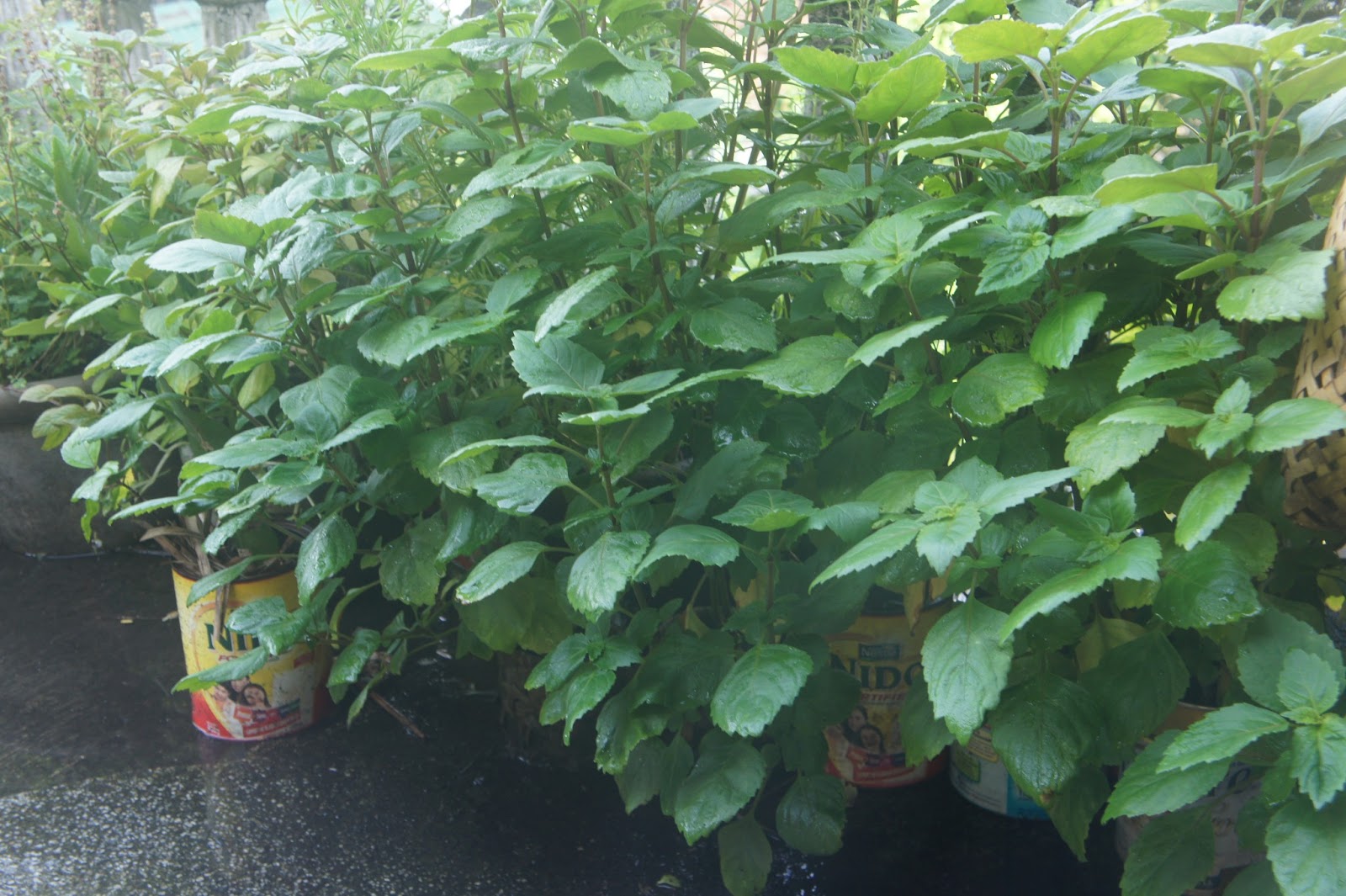
Patchouli locally known as kadlum in Bulusan is lushly growing in my azotea potted garden even with  minimal care.
Patchouli or kadlum are prolific growers. It can even grow in recycled milk tin cans as shown in the above photo of my potted garden in my residence's azotea in Bulusan, Sorsogon.
Kadlum internationally known as patchouli is a popular 'dak'dak' or herbal bath fragrance of Bulusan. Its essential oil is one of the most expensive in the world. It is endemic to the Philippines. However, Indonesia is the leading patchouli producer as listed in leading fragrance journals.

Here are some perfumes with patchouli oil in it: Thierry Mugler Angel, Keiko Mecheri Patchoulissme, Molinard Les Scenteurs Patchouli, Azarro Pour Homme, Balenciaga Homme, Caron French Cancan, Chanel Coco Mademoiselle, Christian Dior Dune, Christian Dior Miss Dior, Clinique Aromatics Elixir, Givenchy Gentleman, Guerlain L'Instant Por Homme, Yves Saint Laurent Kouros and so much more.


A pioneering patchouli oil producer in Sorsogon is currently selling at Php 3,500.00 per liter (farm gate price)for their farm's  locally distilled patchouli oil. 

In the international market, patchouli oil supply was described by the  Market News Service of 2007 as: "supply remains very restricted, demand has been strong, and prices are very high well above the normal long term trading range."

The Lending Model information System for Small-Scale Enterprise in Indonesia shares this information of their patchouli oil industry: Over 80% of Indonesian Patchouli oil is produced in Aceh, North Sumatra and West Sumatra which is mostly exported to industrial countries. Recently, its export-selling price has even reached US$1000/kg in the world market.

It is widely noted in all patchouli literature and references on the net that Pogostemon cablin or locally known as kadlum was bought in from the Philippines to West Sumatra in 1895. It was then cultivated in Aceh and later to Central Java.

Surprisingly, the Philippines to date has no patchouli oil industry, the same with the other essential oils from plants originating from the Philippines. The country's essential oil industry is in fact  tagged as a neglected industry despite its market potential and the available native plant resources.