Showing posts with label Alma P. Gamil. Show all posts

Wednesday, November 14, 2012

Optical Phenomena in Magical Mount Bulusan

Photo: realrica.com


Spectacular solar optic effects at the gaping mouth of Bulusan Volcano! Marvelous nature show.

A fog bow, solar glory, Brocken Spectre 3-in-1 phenomena caught in this one of a kind photograph by the team of Pinoy mountaineers with celebrity climber Ms Rica Peralejo last June 24 of this year.

These are actually three distinct phenomena : The fog bow appears here as a 360 degree white rainbow. The solar glory is a band of colored rings at the inner rim surrounding the shadowy  figure technically known as the Brocken Spectre at the center.

This seemingly supernatural optical phenomenon is rare. One must be at the right location at the right time with the right conditions to produce this atmospheric optical effects. The mountaineers were a lucky bunch to be present on the right spot at the right moment when the crater center was at the perfect moment for this nature spectacle to happen.

The mist of fog or cloud is needed to be at the center of the crater first and foremost. This will serve as the ‘screen’  (as in a movie) for the shadow of the observer standing near the rim of the crater. The sun must be at the back  just like a projector to the observer in whose shadow will be then projected at the thick fog located exactly at the mouth of the volcano.

The effect is optical magic. A marvelous  nature show. Colored rings known as solar glory appears around the head of the Brocken Spectre not unlike colored band of halos. It surely looks like a spiritual apparition for those not familiar with this rare nature phenomenon.

Adding up to the magic is the white rainbow commonly referred to as the fog bow forming the larger circumference--a  giant circular host-like apparition. It is as if the volcano’s crater is about to swallow a gigantic host from heaven.
Solar glories are formed by diffraction where light waves are scattered into a ring-like pattern as differentiated to a regular rainbow that usually appears as a colored arc in the sky which is formed by refraction and reflection. In this photo the glory forms inside the inner rings just above the head of the Brocken  Spectre. 

Do not be alarmed. The Brocken Specter is not a dark ghostly apparition. It is merely an elongated shadow casts into the clouds--the shadow of the observer and most of the time --the photographer/climber. The clouds and fog sort of distort the human shadow as it moves.

The anti-solar point is the exact spot where the solar glory and the Brocken Spectre appear. It is directly opposite the sun from the observer’s perspective.

This atmospheric spectacle is the first time ever recorded inside the crater of  Bulusan Volcano—probably  the only one of its kind in the world.

Written by: Alma P. Gamil
Bulusan, Sorsogon, Philippines

Sunday, November 11, 2012

On Why MBRLC is on Top of my List as My Most Admired NGO

Photo:MBRLC

It is not only because MBRLC (Mindanao Baptist Rural Life Center) was featured in the website of the Yale School of Forestry and Environmental Studies in 2004. It is not also because of its many awards and recognitions:

Awards/Recognitions
*Achievement Award in Technology (1984) from Crop Science Society of the Philippines         
* Ramon Magsaysay Award
(1985) for International Understanding
*DOST-PPM Award in Science and Technology for Private Enterprise (1987) from the Department of Science and Technology
*Presidential Citation (1989) from Her Excellency Madame Philippine President Corazon C. Aquino
*World Food Day Silver Medal (1991) from the regional office of the UN Food and Agriculture Organization
*Regional Likas Yaman Award (1997) from the Department of Environment and Natural Resource


It is mainly because it has given us the hope that abundance is within reach to us ordinary farmers living in the countryside.

By giving us a workable template for appropriate farm technologies and sustainable farming systems that  they themselves are using in their day to day needs, the doubts and fears of our own capabilities somehow lessens.

I t is worth noting that  they only teach what they practice--only technologies tested with recorded success are taught in their own farm classes. The teachers are all practising farmers around the NGO site complex.

Most notable is their version of FAITH (Faith Always in the Home) which when applied by an ordinary farmer with a meager 100 sq meters of  farm lot will secure food on the table for a family of six. This alone addresses the fundamental question of hunger- the most immediate issue and primal fear of anyone who depends on the natural elements (weather fluctuations included)  for food and day to day needs.

The rest of the modules of technology are all worth replicating SALT I, SALT 2 and many more which were all tried and tested with time. Luckily for us, these modules are already available on line for the use of anyone interested to test the method in his/her own small farm.

With the access of these farm technologies and techniques from MBRLC, a farmer will carry within himself an added confidence in his work. And will bring a brighter outlook and hope for every farmer tilling the land knowing that his work is based on a method tested by time and actual practice.

The useful and practical information on farming sytems being shared by the MBRLC were designed specifically for the small farm family.

by: Alma P. Gamil, Bulusan, Sorsogon, Philippines 

references:

MBRLC Profile

www2.mozcom.com/~mbrlc/profile.htm

Religion-Christianity-EP-Mindanao Baptist Rural Life Center (MBRLC)

fore.research.yale.edu/religion/christianity/.../mindanao.html

Friday, November 9, 2012

Magical Mount Bulusan: Ms Rica and the white rainbow

Magical Mount Bulusan. This is not a cliche. This is real.

I saw the magic unravel in the photos of Rica Peralejo-Bonifacio and her fellow trekkers.

They might not know it but they have stumbled upon a very rare phenomenon known as a fog bow during their recent trek to Mount Bulusan.

A fog bow is a 'white rainbow'. White because the colors are so faint it appear whitish. Almost ghostly. But yes the colors are there. And to add to the magic: the white rainbow appeared in a 360 degree form-- meaning a circle. The gaping crater of  Bulusan Volcano appears like in the act of swallowing a  giant Holy host from heaven.

They always say that there is a pot of gold at the end of the rainbow. But this one is not the end of the rainbow (as the photo shows). This one is right at the HEART of a rainbow with the faintest colors of pink, yellow and blue.

More than a pot of gold I am sure is in there-- though not literally.

Whereas a rainbow is the result of the optical effects caused by  droplets of rain meeting the rays of the sun at a specific angle (42 degrees according to scientific journals), the fog bow on the other hand is caused by a mist of fog smaller than rain droplets not strong enough to reflect and refract colors vivid enough to the eyes. Thus a whitish arc or in this case a circle is formed instead.

The sight is truly magical and almost spiritual. It looks like an apparition of nature.

I have checked the web for similar photos of a crater with a white rainbow but none so far yielded to my virtual search. Arctic white rainbow. Yes, sighted by an expedition team. Golden Gate Bridge white rainbow. Yes, as captured by a photographer. But not this kind of a gaping mouth of a volcano with a giant 'host', the Eucharistic bread from heaven in a suspended  freeze frame waiting to be swallowed by the magnificent Bulusan Volcano from the hands of the  holy sky.

To the trekkers and to the beautiful Ms. Rica Peralejo-Bonifacio:

All I can say is: wish I was there!         (Photos: realrica.com)
http://realrica.com/blog/wp-content/uploads/2012/06/GOPR0260.jpg
For the complete set of photos from Ms Rica Peralejo Bonifacio with the white rainbow: realrica.com

http://realrica.com/blog/wp-content/uploads/2012/06/GOPR0260.jpg

Friday, November 2, 2012

All Saints' Day Photography 101 in Bulusan

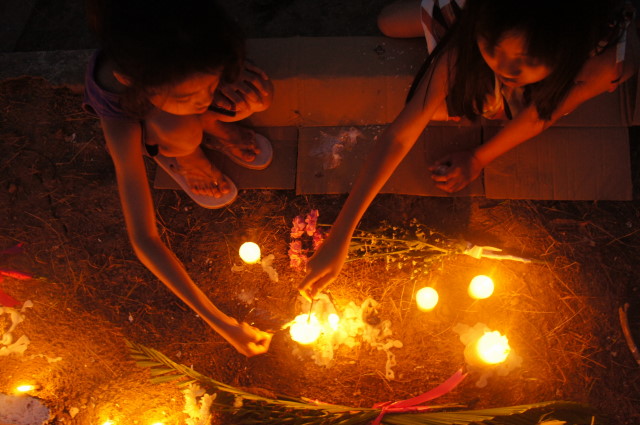
The cemetery never fails to yield dramatic photographs. This is true whether in its ordinary desolate days and during All Saints' Day and All Souls' Day celebrated November 1 and 2 when the cemetery is full of life.


For those living in the city a trip back home during these days to visit their loved ones (both the living and the dead) are customary. And the visit to the cemetery is the highlight of the trip.

But for some young ones who tugged along with their moms and dads this can be a boring activity. So a little creativity is needed to inject interest to my nieces for the obligatory visit.

My teenage niece Ging dubbed it as Photography 101, Subject: Todos Los Santos in Bulusan. The younger ones Yapa and cousin Angie acted as the models. Me and Ging as the photographers.

The above photos were some of the captured scenes.


Bulusan, Sorsogon, Philippines


Monday, October 29, 2012

Blog about a tourist blog of my hometown Bulusan

Reading the blog of islandgirltraveller.com was a relief from the usual destinations themed blog about my hometown. This blog is about the daily routine of the common folks as she sees it in situ. The pictures were taken from the market, in the streets, common folks doing their daily routine. She captured it as is.

I just hope she was able to visit the usual tourist route and the less known sites too. Because the slow-paced quiet town as she sees it is in fact a keeper of magnificent grand sights such as the volcanic landscapes of Mount Bulusan, the coral-rimmed beaches along her shores, mountain springs  with soda like waters, gushing water falls, moist and foggy rainforest with a lot of surprises, zen like calmness of an emerald lake and so much more.

Thanks for the visit Ms islandgirltraveller.

(You may want to visit islandgirltraveller.com blog entitled The Quiet Town of Bulusan, Sorsogon for her story about my hometown).


Bulusan, Sorsogon, Philippines

Saturday, October 27, 2012

Bulusan's Bamban


Bamban plant in Bulusan

Bambam stems are excellent materials for fish trap weaving.

Beginning weave of a fish trap - in Bulusan.

The ASEAN Tropical Plant Database is very specific in its description of the Philippine bamban (Scientific name: Donax cannaeformis (G. Forst.) K Schum.

Fish traps locally called 'bobo' are made from bamban strips from the split stems of this species sustainably harvested by local  fishermen weavers from the nearby farm patches and second growth forests. These bamban (photo) are lushly growing in the hilly part of Barangay Dancalan, Bulusan.

Photographs by Alma P. Gamil
Bulusan, Sorsogon, Philippines


Tuesday, October 2, 2012

Ilóg is the local term for the pili kernels

The recent low pressure area brought slight winds in Bulusan strong enough for some unripe pili fruits to fall off from some pili tree branches in our nearby farm patch in Kapilihan giving us some crispy fresh nuts to munch on.

These kernels are traditionally not use for the confectionery pili sweets. These are not bought by traders too since pili of this kind cannot last for long periods of storage customarily done in the pili trade.

The colors of unripe fruits of the pili ranges from green to greenish purple the locals call 'bulaga'.  The kernels are best eaten raw.

Bulusanons know by heart the taste of these unripe pili kernels. It is part of their childhood memories where once upon a time pili fruit 'hunting' was part of their childhood adventures.

A chef friend described to me the taste of the unriped pili kernels as having a sweet nutty taste with a dill-like flavor.

I have grown dill before in my garden and can honestly say that the description fits exactly.

For pickles' freaks like me, this is the perfect ingredient!

Bulusan, Sorsogon, Philippines

Sunday, September 9, 2012

Kadlum is the high-end Patchouli

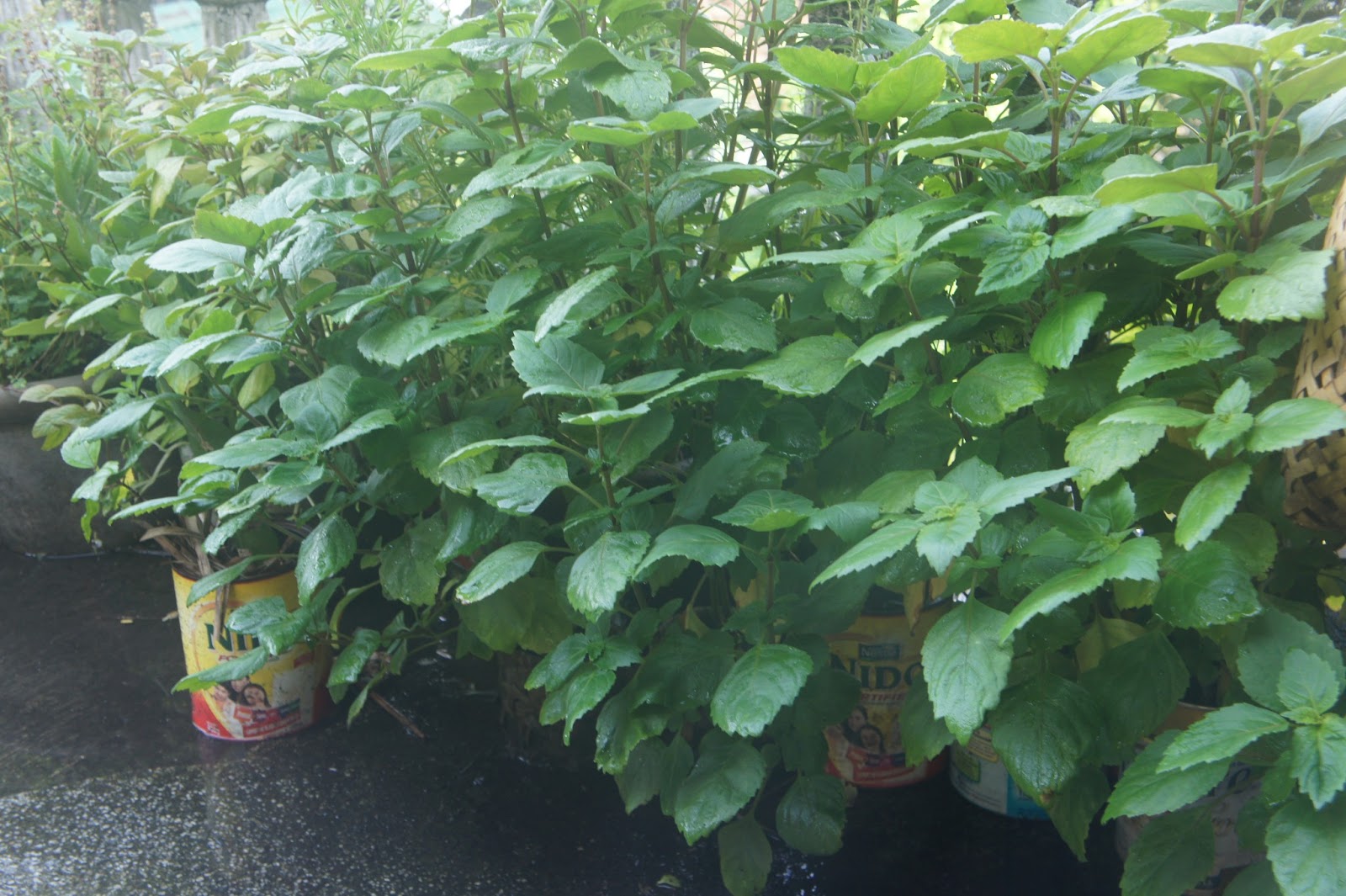
Patchouli locally known as kadlum in Bulusan is lushly growing in my azotea potted garden even with  minimal care.
Patchouli or kadlum are prolific growers. It can even grow in recycled milk tin cans as shown in the above photo of my potted garden in my residence's azotea in Bulusan, Sorsogon.
Kadlum internationally known as patchouli is a popular 'dak'dak' or herbal bath fragrance of Bulusan. Its essential oil is one of the most expensive in the world. It is endemic to the Philippines. However, Indonesia is the leading patchouli producer as listed in leading fragrance journals.

Here are some perfumes with patchouli oil in it: Thierry Mugler Angel, Keiko Mecheri Patchoulissme, Molinard Les Scenteurs Patchouli, Azarro Pour Homme, Balenciaga Homme, Caron French Cancan, Chanel Coco Mademoiselle, Christian Dior Dune, Christian Dior Miss Dior, Clinique Aromatics Elixir, Givenchy Gentleman, Guerlain L'Instant Por Homme, Yves Saint Laurent Kouros and so much more.


A pioneering patchouli oil producer in Sorsogon is currently selling at Php 3,500.00 per liter (farm gate price)for their farm's  locally distilled patchouli oil. 

In the international market, patchouli oil supply was described by the  Market News Service of 2007 as: "supply remains very restricted, demand has been strong, and prices are very high well above the normal long term trading range."

The Lending Model information System for Small-Scale Enterprise in Indonesia shares this information of their patchouli oil industry: Over 80% of Indonesian Patchouli oil is produced in Aceh, North Sumatra and West Sumatra which is mostly exported to industrial countries. Recently, its export-selling price has even reached US$1000/kg in the world market.

It is widely noted in all patchouli literature and references on the net that Pogostemon cablin or locally known as kadlum was bought in from the Philippines to West Sumatra in 1895. It was then cultivated in Aceh and later to Central Java.

Surprisingly, the Philippines to date has no patchouli oil industry, the same with the other essential oils from plants originating from the Philippines. The country's essential oil industry is in fact  tagged as a neglected industry despite its market potential and the available native plant resources.