Showing posts with label Pili. Show all posts

Sunday, February 3, 2013

Pili: Bicol's Heritage Flora


"If forests were not disturbed, this would
have been the safest place to permanently
keep these valuable plant resources."

                    -Roberto E. Coronel, foremost fruit scientist of Asia                
                 

A volunteer Pili tree standing tall along with coconut trees in a farm located in the fringes of Mount Bulusan.
A very strong argument on why the rainforest of Bulusan must be preserved is the definitive scientific paper on Pili authored by Roberto E. Coronel. This study (1996) was made possible by the Institute of Plant Genetics and Crop Plant Research, Gatersleben/International Plant Genetic Resources Institute,Rome, Italy. The study aims to promote the conservation and use of Pili.

Buttressed trunks of Pili trees are most adapted to typhoons. Pili is a resilient plant antedating climate change adaptation.

The stony shell of  the Pili  nut is not a problem in Bulusan. The 'paratilad' or manual de-shellers can retrieve the kernels within seconds by using only a simple bolo.

Part of the study reads:

"Origin and geographic distribution:
The pili is indigenous to the Philippines (Merrill 1912, 1923; Wester 1921; Brown 1954; Li 1970). The crop’s centre of genetic diversity is the Bicol region, possibly in the virgin rainforests surrounding Mt. Bulusan, in the Province of Sorsogon. In the forests of this province, very old pili nut trees measuring more than 50 m in height can still be found today." 

The pulp of the ripe pili  fruits are also source of food  and oil. But the kernels are the most prized.

The planned conversion of the surroundings of Mount Bulusan into a Geothermal Field zone will alter irrevocably the natural habitat chosen by the Pili in its course of evolution that probably took million of years to complete. The species' choice of place is a cocktail mix of many variables : volcanic heat, heavy dose of rainfall, tropical Pacific Ocean, dense rainforest and just being in the right geographical location preferred by the pili.

Pili resin is internationally known as Manila elemi, ingredient for perfumes and pharmaceuticals and  recently for beauty products.
Pili was aptly described  as growing "at the heart of the Pacific Ocean, the island of Luzon..." by an international beauty product ad. The product utilizes the manila elemi, the resin from the pili tree as an ingredient. It highlighted the place of origin of the natural plant resource--the Philippines.

This and many others international recognitions underscore the importance of the Pili as an indigenous plant. And thus, Mount Bulusan being the keeper of the Pili's original genetic pool needs utmost vigilance from the continued threat of 'industrial development' to guarantee that the Pili of the ovatum kind will continue to flourish in perpetuity.

The eminent scientist, Doctor Roberto E. Coronel articulated the following in one of his seminar lectures:

Biodiverslty Conservation Systems
 In Situ Conservation
- All fruits and nuts have evolved as plant
species in the forests.
-If  forests were not disturbed, this would
have been the safest place to permanently
keep these valuable plant resources.


Photos by Alma P. Gamil
Bulusan, Sorsogon


Saturday, January 26, 2013

Pili Diversity in One frame

Few meters away from the border of Bulusan Volcano Natural Park are diverse pili trees (three kinds of pili in this photo alone) noticeably all volunteer growths i.e. planted by wild animals. The photo above looks ordinary in these areas. Canopies of  Canarium ovatum (pili) could be sighted inside and around the BVNP borders corroborating the fact of what was  recorded in the definitive Pili monograph by Roberto E. Coronel, the eminent fruit scientist that Mount Bulusan is probably the center of genetic diversity of Pili.
Prolific Pili tree at the background is the elite kind of pili found in Mount Bulusan.

Zoom in the framed photograph and you will see that the background pili tree (compared with the foreground pili tree) is filled with fruits still green and thus blends with the leaves unnoticed. This kind of prolific pili tree fruiter is the elite variety of pili prized by horticulturists.

I seized the opportunity to ask from the farm owner for a handful of ripe pili nuts (fruits are colored black when ripe) for my potted nursery.

Photo: Taken at the BVNP border by  Alma P. Gamil

Bulusan, Sorsogon, Philippines

Friday, November 30, 2012

How to get the pili kernels out of the hard shell?


Photo: http://pamughaton.wordpress.com/2012/11/23/parabuong/
Paratilad in Bulusan doing the deshelling job for a local pili nut trader in Poblacion Central 

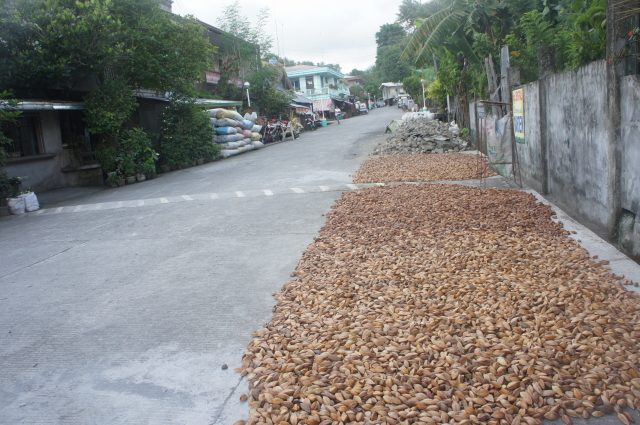
'Lagting' is the local term for the pili sans the pulp. After 2 to 3 days of sun drying these pili seeds (stones in botanical parlance) can last for more than a year in storage. The precious kernels will remain protected by the stony hard shell during this period with the right amount of sun drying done. During this stage the kernels inside the hard shell shrink a little ('reseko') due to moisture loss allowing it to naturally detach from the shell while still inside the shell thus saving a lot of effort in retrieving the kernels for the next process.

A closer look of the 'lagting'
The next process will be the manual deshelling or 'pagtilad'. Most often the schedule of this post production process depends solely on the pili traders who usually follow the dictates of the market's most profitable time to sell the pili kernels locally known as 'ilog'.

The 'paratilad' or skilled pili nut sheller of Bulusan can open the shell in a split second separating the kernel whole and the shell cut into two perfect cone shaped half shells called binung-an. The kernels fall out automatically in the process unharmed.The technique lies in the positioning and angle of the bolo (shown in the above photo of a paratilad second from right) and the precise hitting of the shell. The paratilad knows this technique almost intuitively.

In the province of Sorsogon, it is commonly observed in the pili confectionery industry that the paratilad either came  from the district of Bacon or from Bulusan town.  Those from Bulusan are probably a lot since any day of the year the paratilad are always available for the  job.

Bulusan pili nuts are known to be stout with larger kernels
One anecdote from a local resident tells a story on how a local paratilad beat the pili deshelling  machine of  a government agency during a dry run test in a bid to mechanize the system. Hands down the winner was the paratilad the resident related with a big guffaw. No breaking news about that machine test incident in Bulusan  though it became a favorite pili industry story. The paratilad beating the machine* clearly demonstrates how an indigenous skill of 'pagtilad' is truly an indispensable factor in the pili industry as a whole. To this day the traders still rely on the paratilad for their deshelling process. Pagtilad is in fact an indigenous livelihood synonymous with the pili nut. Each paratilad could easily retrieve pili kernels from 2 sacks of pili nuts or 'lagting' in a day.  An average of 100 kilograms of pili nuts de-shelled in a day by one paratilad is a conservative estimate.
  
Pili nuts spread evenly for uniform drying 
Roam around Bulusan town and check for an on-going 'tiriladan' acitivity in a pili trader's bodega, you might be lucky to chance upon these skilled paratilad making precise mini samurai strokes on the pili shells quietly seated on the floor with only a tuktukan (a wooden hard board) so as to perfectly position the lagting and a dependable bolo as tools of their trade.It is fascinating to watch the pili kernels fall off from the half cone-shaped binung-an in perfect rhythm to the sound of the lagting deshelled one pili nut at a time.   


The post production process of 'pagtilad' is probably as old as the utilization of the pili nut itself. The traditional skill could only arise from the pili growing areas like Bulusan. It will not be a surprise if the local paratilad will service also emerging pili nut areas with cultivated pili crop.
Pili nut sun drying on the street in Poblacion Central (Photo: Alma P. Gamil)

 *Note: According to Trade Winds Bicol, a DTI 5 Quarterly publication the "Pili deshelling machines are not quite successful as they do crush the extremely hard, bony shell, but unfortunately tend to crush the precious kernel as well, in statistics too high for commercial viability. "


Bulusan, Sorsogon, Philippines


Tuesday, October 2, 2012

Ilóg is the local term for the pili kernels

The recent low pressure area brought slight winds in Bulusan strong enough for some unripe pili fruits to fall off from some pili tree branches in our nearby farm patch in Kapilihan giving us some crispy fresh nuts to munch on.

These kernels are traditionally not use for the confectionery pili sweets. These are not bought by traders too since pili of this kind cannot last for long periods of storage customarily done in the pili trade.

The colors of unripe fruits of the pili ranges from green to greenish purple the locals call 'bulaga'.  The kernels are best eaten raw.

Bulusanons know by heart the taste of these unripe pili kernels. It is part of their childhood memories where once upon a time pili fruit 'hunting' was part of their childhood adventures.

A chef friend described to me the taste of the unriped pili kernels as having a sweet nutty taste with a dill-like flavor.

I have grown dill before in my garden and can honestly say that the description fits exactly.

For pickles' freaks like me, this is the perfect ingredient!

Bulusan, Sorsogon, Philippines