Showing posts with label Bicol region. Show all posts

Tuesday, March 4, 2014

Mindful along the road

Bulusan is a visual community that can inspire so many photographs even those coming from an amateur like myself. Photography is the main reason why I created this blog. To be true to this site's original calling, I will be converting this site into a gallery of photos from my hometown Bulusan.

'Mindful along the road' will be my first set.

Countryside, Bulusan, February 2014.

Overlooking an old lava flow, Sitio Porog, Bulusan, 2014. 

Bulusan Volcano, February 2014.

Coconut grove, Dancalan, Bulusan, February 2014.

Road view, Dancalan, Bulusan, February 2014.

Photographs by Alma P. Gamil
Bulusan, Sorsogon, Philippines, February 2014

Friday, October 4, 2013

Mt. Bulusan : 'A Special Place in Philippine Botany'

Palali (sometimes pronounced/spelled as Palale) is a pure white katmon relative that flourishes abundantly in the mountains of Bulusan. http://phytoimages.siu.edu/imgs/pelserpb/r/Dilleniaceae_Dillenia_reifferscheidia_75128.html
Receiving encouraging words from no less than a distinguished scientist was one of the  most rewarding experiences in my personal foray into flora photography in my hometown.

Dr James LaFrankie, author of the book  An Illustrated Guide on Asia's Tropical Trees posted the following in the FB page of the Co's Digital Flora of the Philippines :
"...you are getting a great collection of photographs of all sorts of interesting plants... Mt. Bulusan is a special place in Philippine botany so keep building your collection..."

Dr James LaFrankie attained his PhD in Biology from Harvard University. He is now a professor at the Institute of Biology, College of Science at the University of the Philippines Diliman.

I did not expect that my simple contributions of flora photos from Bulusan will be noticed. My only aim is to at least make some listings with photos of the flora that are found in Bulusan. This encouragement therefore is a signal for me to continue this plant listing activity one species at a time for as long as I can still hold a camera to photograph these immense biodiversity.

Furthermore, this marvelous information that Mt. Bulusan is "a special place in Philippine Botany" also underscores the importance of the preservation of its natural conditions. For me it means that Mt. Bulusan and its adjacent areas must first and foremost be NOT converted into an industrial field such as that of a Geothermal field zone that will alter irrevocably its surrounding ecosystem.

Photo: Alma P. Gamil
BVNP - Bulusan Volcano Natural Park
Bulusan, Sorsogon, Philippines

Wednesday, June 19, 2013

Kagawad Eddie G. Frando : Green Councilor of Bulusan

Kagawad Eddie G Frando's souvenir shot of the Bulusan EcoTrail Run 2013 as it appears in his FB account.
Ms. Earth beauties with outgoing Councilor Eddie Frando (extreme left in the photo) and  participants  of the recently concluded Bulusan EcoTrail Run Year Three event are shown here brimming with enthusiasm and excitement. The event is an LGU sponsored activity for its continuing green awareness campaign and to boost ecotourism in the municipality of Bulusan.

Kagawad Frando an outgoing Municipal Councilor co-authored with Councilor Cecil Frades the landmark Sangguniang Bayan Resolution banning Geothermal and other industrial development in Mt. Bulusan and thereby  preserving its pristine nature in perpetuity for the benefit of succeeding generations of Bulusanons.

Mt. Bulusan is an active volcano, one of the five intensely active volcanos (or volcanoes both are correct) in the Philippines (Taal, Mayon, Bulusan, Kanlaon and Hibok-hibok) whose location is close enough to large communities to be of major concern.The Philippines has a total of 405 volcanoes of which  23 are active,  27 potentially active and 355 inactive according to the released information from Phivolcs.

The SB resolution is often cited by environmental advocacy groups in the Philippines and those sectors opposing unwise choice of location for Geothermal Projects that negatively impact the communities near it.

I have however no knowledge of the stand of the visiting beauties regarding the Geothermal dilemma in Bulusan.

Further information on the landmark Resolution: http://bulusanruralvagabond.wordpress.com/2013/02/06/bulusan-lgu-shining-moment-for-ecology/


Photo credit: Kagawad Eddie Frando of LGU Bulusan 
Bulusan, Sorsogon, Philippines

Thursday, June 13, 2013

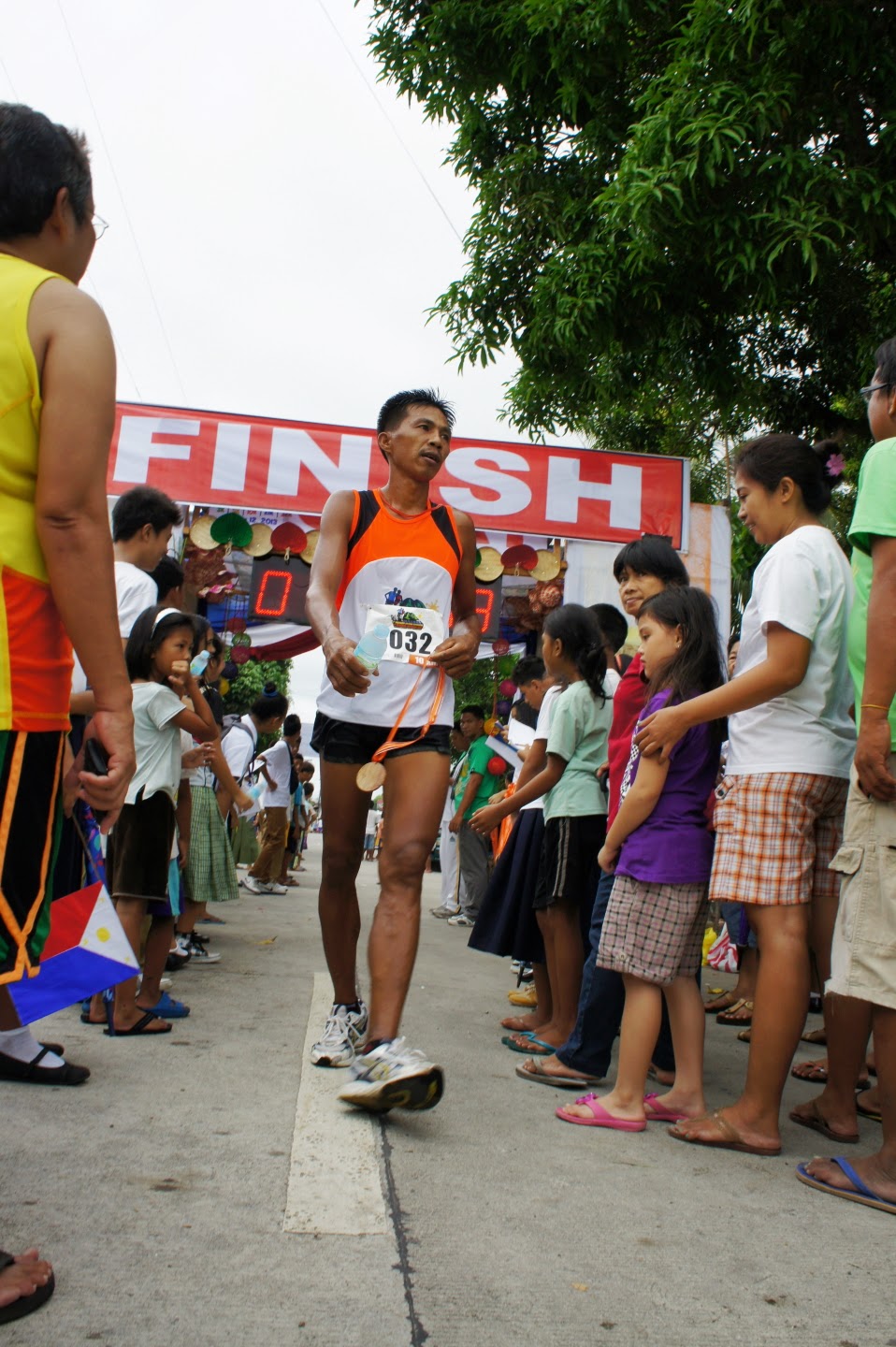
Bulusan EcoTrail Run Year Three

Only on its third year and the result is outstanding in terms of overall performance. The positive impact of the Bulusan ecotrail run to the ecotourism direction of Bulusan town is one of the legacies the outgoing administration can be proud of. This is an objective assessment as shown in the reception and acceptability of the activity  to the local residents. The overwhelming support especially from the students and youth sector is so high. Ms Earth beauties gracing the event also adds up to up-scaling of this year's ecotrail run to have that look of a national event - a yearly ecotourism calendar date for Bulusan. Definitely not just a parochial community affair.

However I was not able to push my way inside the thick crowd during the fun run time of the guest beauties wearing the Bulusan ecotrail run uniform. This enabled me to focus my attention to my town mates instead whose enthusiasm and excitement rubbed on me that  day. Fun filled energy was so contagious.

In my photos, the real stars of the ecotrail run were the local runners, the interesting array of local participants, the kids all ready to run in complete running attire, the drummer boys/girls,  the medal girls attending to the details of giving away medals to the 'finisher' etcetera etcetera. And oh...don't worry about the photos of the Ms Earth beauties. There are already some posted in the FB sites of my town mates as of this hour :)

All revved up for the event


The kids in complete running uniform

Mayor Myke Guysayko (extreme left in the photo) leading the event - an eventful and bittersweet exit as outgoing executive of Bulusan town  for a new term in the Provincial Sanggunian Board.


Eye-catcher in orange hair


Bright future for Bulusan kids in ecotourism

Starting point ready to record up to the last seconds

Yes, the Ms. Earth beauties were here!

Attention to details include these too!

A 'finisher' receiving the green medal

Eager local press from Bulusan High School

A camera man from the ABS-CBN Bicol records the event.

Winner for the 3km category

Another 'finisher'

June 12 is Independence Day.

Bulusan beauties as medal girls

A finisher for the orange category

...for the yellow category

A street view of the start and finish lines of the running stretch

Bulusan's internet connection is quite strong

A deserved medal for a prepared runner

A refreshing finish


Photos: Alma P. Gamil
Bulusan, Sorsogon, Philippines

Wednesday, June 5, 2013

Young boy and the sea


 It took only a few minutes for this boy to enjoy the sea from a tentative to a let-go stance. Photos were taken in Dancalan beach now a favorite family picnic site by the local residents and those from the neighboring towns as well.
Dancalan Beach, June 4, 2013

Photos:  Alma P. Gamil
Bulusan, Sorsogon, Philippines


Sunday, May 26, 2013

Agoho and Bulusan Volcano


"The mountain agoho (Casuarina rumphiana), which is known to have a very limited distribution in the Philippines and Southeast Asia, inhabits this protected area," reads part of the assessment report re BVNP of the team of Errol Gatumbato a noted environmentalist in the Philippines.  By protected area, this refers to  BVNP, Bulusan Volcano Natural Park located in the composite mountains of Bulusan Volcano (above and below photos). 
Some of these trees found its way in the lower areas of Bulusan comprising the residential areas. I have seen one big agoho at the churchyard and several at the cottage  grounds of Dancalan beach where this photo was taken.  The dangling leaves that fringe the upper  frame of the above photo are from an old agoho tree standing beside the open cottages in Dancalan beach. The electric wires along the road  run across the photo from this vantage point.

Bulusan Volcano (composite mountains) as it appears on a cloudless day, May 26, 2013.
Photos: Alma P. Gamil
Bulusan, Sorsogon, Philippines

Friday, May 17, 2013

Enchanted and enchanting Miligabiga


Miligabiga beach of Bulusan, Sorsogon. Prepare yourself to be enchanted literally.
Miligabiga is a photographer's delight not only because its beauty is magnetic but because you can only savor this breathtaking seascape after passing through a series of beaches with varied traits of its own. Traversing this seemingly long stretch of kaleidoscope beaches is like undergoing a mini fairy tale story of finding the coveted treasure at the end of the journey.

Getting there (to Miligabiga beach) one will pass through to a long stretch of around four kinds of beaches : black sand, pebble beach, rock beach and finally the cream grey hue of the fine sand of Miligabiga. The boundaries of the beaches are delineated by the kind of beach description it has. For example the rock and pebbled beach is Riroan beach, the black sand beach is Katorse Puno while the final beach at the far end is Miligabiga.

Miligabiga is a seascape that will hold you by the edge of your senses. It is a visual feast alright but the sound of the ocean also vies for attention. The acoustic ecology here is just awesome. You can feel that the ocean is alive and intense even on a calm day with its oceanic wailings and breathing that reverberates infinitely in the entire seascape. The waves too are always dancing passionately inviting the most adventurous of surfers. The fear factor though of not going back safely to shore was on my mind. Not for beginners I said to myself while observing the series of waves with full bodied crest crashing on the edge of the beach and back again to the deep blue.

Miligabiga is at the far end of the sea coast of Barangay Mabuhay bordering Barangay San Bernardo of the Municipality of Bulusan. The vast Pacific Ocean provides an awesome backdrop to the picturesque seascape.

Photo and Video by Alma P. Gamil
Bulusan, Sorsogon 
Philippines

Thursday, May 2, 2013

What saved the abaca of Odikin?


Recent photos (above and below) of healthy abaca plants almost as big as the average banana thriving disease-free in the mountain village of Odikin (Santa Barbara) along the slopes of Mount Bulusan.


While researches and government funded programs are still on-going as of this writing in a bid to rehabilitate the abaca industry which was almost wiped out in the Bicol Region because of the dreaded bunchy top virus (scientific researches already include cloning of abaca accessions resistant to the disease to searching for a local variety that can be proven immune to the bunchy top virus), here comes these well, very healthy looking abaca crops (photos) greeting me in my mountain stroll early week of April.

I was expecting an almost annihilated abaca population based on my several readings on the subject. So this comes as a surprise! Is the abaca 'variety'of Odikin and neighboring mountain villages resistant to the virus? Is the local accession growing here has the genetic make-up to ward off the disease?

My main guess is that these abaca crops were shielded by the ecosystem itself. Odikin's rich biodiversity  creates a natural form of protection not unlike to a healthy body that wards off diseases and infections. Observing the assorted crops and wild flora growing side by side where these abaca also thrive one could safely conclude that the seemingly forested farms provide a natural check and balance of pests and diseases. The long held principle being espoused by the natural farming system that nature has a built-in healing and protection mechanism that controls and prevents the spread of pests and diseases among plants seems to work here. Nature heals itself as long as the ecosystem remains healthy.

This observation however calls on abaca research institutions to check on these local 'resistant' abaca crops in the village of Odikin. A thorough study on why they were saved from the destructive abaca disease perhaps will contribute much to update abaca cultivation practices. A scientific documentation will be most helpful.

Abaca in the form of Manila hemp locally referred to as 'bandala'  was one of the major agricultural products of Bulusan next only to coconut. The state of abaca farming in Bulusan were discussed in several posts in Pamughaton, a Bulusanon web site as follows: Industriya sa bakilidHalayhayan and Namandala. These posts echo the sad reality of Bulusan's abaca farmers and the parahag-ot i.e. abaca strippers.

FIDA (Fiber Industry Development Authority of the Department of Agriculture) released information on  abaca's agricultural history reads: "The abaca plant is indigenous to the Philippines whose warm, wet climate and volcanic soils are particularly suited to its cultivation. It has been grown in the Philippines for centuries, long before the Spanish occupation.  When Magellan and his companions arrived in Cebu in 1521, they noticed that the natives were wearing clothes made from the fiber of abaca plant, noting further that the weaving of the fiber was already widespread in the island."


Photos by Alma P. Gamil
in Santa Barbara, Bulusan, Sorsogon
Philippines


Thursday, April 25, 2013

Palogtoc Falls back to nature


The true 'green' mower for this expanse is the ever reliable Philippine carabao that keeps this coconut farm patch  always freshly trimmed and neat looking.

Thumbs up for the carabao - a perfect bio-grass mower. This local grass species that the carabao grazes on is called (what else?) - carabao grass.


Local villagers from the vicinity of  Palogtoc Falls enjoy free plunge and bath according to a local teen - at least for now. We however paid 25pesos each as entrance fee.


The overflowing waters from the big pool that catches the waterfalls is still as fresh and clear as the Falls itself. The  presence of several local villagers mostly kids enjoying a cool plunge and bath is not enough to dilute the water's quality because of the sheer volume of it.


The local villagers know exactly how to frolic with the waters of Palogtoc Falls.

A long and shaded journey of a gushing mountain stream manifests itself into a beauty here in Palogtoc falls.  The waters  still  carry the taste of subtle mineral waters.
My niece, Yapa (in red attire) and cousin An-ge enjoying the 'bunlawan'  (rinse area) that serves also as a kiddie pool. This is just beside the big pool where the Palogtoc Falls continuously refresh and replenish the waters with its rushing head stream.
Embracing the front and sides of Palogtoc Falls are brooks and rivulets which are captivating on their own.

The brook fronting the Palogtoc Falls sings a melodious water sound complementing the louder sound of the rushing voice of the water falls.

Palogtoc Falls was actually a third choice for a Sunday  picnic destination for three visiting nieces for the summer break. Fulo Resort and Masacrot Spring were overflowing with visitors so as to make us turn our gears to Palogtoc. The headtrail of Palogtoc that starts along the road needs a walk of around 500 meters, enough to discourage those that flocked to the other pools along the road.

We found out however, that the 500m walk to the lovely nature grotto that is Palogtoc is worth the extra walk not to mention the sights near the end of the trail - a green-always-freshly grazed carabao grass expanse under a coconut farm patch courtesy of a mainstay carabao mower. The trail has no signage as to where we are going.

The only sign that gave as the clue that we are nearing Palogtoc Falls is the sound of the rushing waters that becomes louder and louder as we are nearing the Falls and makes one imagine in advance what to expect - fresh and abundant flow of mountain spring that converge into a big stout water falls. Short water falls actually since the rest of it is hidden. The water falls that is visible at the big 'gorgeous' pool is in fact an end point of a low lying source of rushing hidden and shaded waters.

Palogtoc is so lovely alright (as described by Lonely Planet in its review) with the elemental nature feel to it. Like a fairy land, says my niece. She is referring of course to the abundant giant ferns, wild trees, and tropical flora forming an impressive array of a picturesque tropical mountain paradise!

The drawbacks however were articulated also by my nieces - where is the CR? where is the changing and wash room? where are we going to pee?
Me for one was puzzled too on what happened to Palogtoc.  It seems that its management has relegated to nature even the simple amenities mentioned by my nieces.

I just answered the girls with this: Go back to the  smaller pool (used as rinse pool or 'bunlawan') and take a pee there while on a dip, the flow of the waters will exit to  the side brook and will not affect the main pool of the Falls.

Back to nature. Back to the free water fun for the local villagers.

Note: Heard from the local grapevine that Palogtoc property is currently for sale. This needs verification though for those who are interested.

Palogtoc Falls, Bulusan, Philippines
Photos by Alma P. Gamil