This coming Sunday, in an elaborate folk theater complete with props and a 3-story tall structure tower, an angel will descend from here to lift the black veil off the Blessed Mother's face. This signifies the end of mourning and the peak of the celebration-The Resurrection. Aleluya in Bulusan.
Tristan with his young frame--not yet a teener (but not too young to be always in the company of her watchful mom), will have the chance of a life time to do the task. A feat since he will be fastened in a contraption that looks like an enlarge chicken nest. This will slowly descend as he sings in his angelic voice the 'Aleluya' song that he has been practicing for weeks now under the tutelage of a local cantora.
Let us wish Tristan a successful and and shining performance on his momentous and glorious role--lead angel soloist of the 'aleluya' event in Bulusan. In the local parlance, he will be the 'madagit', an allusion of a flying angel from above (heavens). In one swift precise move Tristan must be able to lift the veil not unlike that of a bird of prey snapping a prey-thus the name 'dagit' which means to snap. The black veil covering the face of the mourning Blessed Mother will be the target as she passes by during the early morning procession prior to the main event.
Photos show a confident but shy Tristan on his way home to Lubas, San Rafael after the Palm Sunday Mass and Hosana in Bulusan. Also in the photo is his mom and younger brother (obviously too tired and sleepy because of the early dawn 'hosana' singing chores around the Poblacions of which both of them were members of the choir for the Palm Sunday 'hosana'). The same choir will perform in the Aleluya event.
Palm Sunday is 'hosana' in Bulusan.
Photographs by Alma P. Gamil
Bulusan, Sorsogon, Philippines
Monday, March 25, 2013
Portraits of two 'Hosana' angels
After warming up with my short friendly chats in the dialect, the 'angels' obliged to friendly poses as opposed to the initial astonished poses. It took only minutes for the girls to change from hesitant to friendly. My short chats immediately changed their mood, an attitude that is typical of the friendly nature of the Bulusanon.
The two angels were delighted to pose for these two souvenir shots of 2013 Palm Sunday for me. Their natural friendliness shine even in the photo.
Photographs by Alma P. Gamil
Bulusan, Sorsogon, Philippines
Sunday, March 24, 2013
Palm Sunday Images in Bulusan
The Palm Sunday event was a visual feast so beautiful and unbearably light. So distinctly Bulusanon.
Images by Alma P. Gamil
Saint James the Greater Parish Chuch/grounds, Bulusan, Sorsogon
Philippines
Friday, March 22, 2013
The 'teen weaver' photo
Hilda Espano was actually twenty (she looks younger than her age) that year (2011) when I photographed her in their open anahaw hut in Sitio Tawog. With an earphone plugged on her ears, she was busily chatting on the phone with her friends and weaving at the same time while I continuously take photos of the weaving and its milieu.
The setting was typical in Bulusan. As I'd expected, there were the usual tools of the trade (hurmahan i.e. wooden block, hiyod or bamboo stick karagumoy strips softner, stone polisher etc.), the strewn unfinished karagumoy hats, the strips of karagumoy ready for weaving and the almost finished hats ready for trimming and soon for delivery to the nearest trader just across the street--a sari-sari store that sells also cell phone loads for Hilda's use. She told me though that most of the proceeds of the hats after weaving go to the more important daily household needs and for petty cash as well.
Photograph by Alma P. Gamil
Bulusan, Sorsogon, Philippines
Tuesday, March 19, 2013
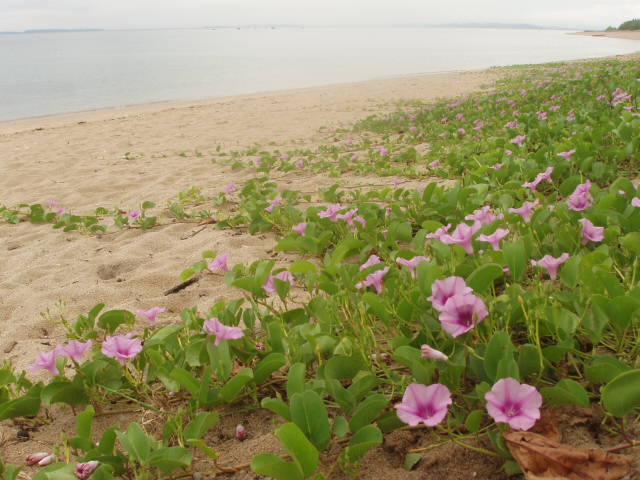
Ragayray is Ipomoea pes-caprae
According to my co-members at the Co's digital Flora of the Philippines FB site, the scientific name of this very familiar crawling vine (ragayray to us in Bulusan) growing lushly and wild near the beaches of Bulusan is Ipomoea pes-caprae.
Though not rare, this plant's botanical name seems to bestow it a sense of a special quality making me looked closely to the minute details-- the color hue of the flower, its veins, the shape of the leaves etcetera. Assigning formal names gives the plant (for example this common ragayray) a sort of identity for us to take notice and be more mindful of our surroundings including the familiar and the common.
Ordinary flora are commonly taken for granted because of their ordinariness. Familiarity sometimes makes a thing invisible to our sight even though it is right in front of us.
By committing to memory ragayray's formal name, it suddenly becomes extraordinary! The name even sounded like a spell to me while I repeatedly practiced the right way to say it. Ipomoea pes-caprae. Ipomoea pes-caprae. Ipomoea pes-caprae...
Photographs by Alma P. Gamil
Bulusan, Sorsogon, Philippines
Thursday, March 14, 2013
Finding Merton one slow afternoon in Bulusan
For, like a grain of fire
Smouldering in the heart of every living essence
God plants His undivided power –
Buries His thought too vast for worlds
In seed and root and blade and flower,
The Sowing of Meanings
by Thomas Merton
See the high birds! Is their’s the song
That dies among the wood-light
Wounding the listener with such bright arrows?
Or do they play in wheeling silences
Defining in the perfect sky
The bounds of (here below) our solitude,
Where spring has generated lights of green
To glow in clouds upon the sombre branches?
Ponds full of sky and stillnesses
What heavy summer songs still sleep
Under the tawny rushes at your brim?
More than a season will be born here, nature,
In your world of gravid mirrors!
The quiet air awaits one note,
One light, one ray and it will be the angels’ spring:
One flash, one glance upon the shiny pond, and then
Asperges me! sweet wilderness, and lo! we are redeemed!
For, like a grain of fire
Smouldering in the heart of every living essence
God plants His undivided power –
Buries His thought too vast for worlds
In seed and root and blade and flower,
Until, in the amazing light of April,
Surcharging the religious silence of the spring,
Creation finds the pressure of His everlasting secret
Too terrible to bear.
Then every way we look, lo! rocks and trees
Pastures and hills and streams and birds and firmament
And our own souls within us flash, and shower us with light,
While the wild countryside, unknown, unvisited of men,
Bears sheaves of clean, transforming fire.
And then, oh then the written image, schooled in sacrifice,
The deep united threeness printed in our being,
Shot by the brilliant syllable of such an intuition, turns
within,
And plants that light far down into the heart of darkness
and oblivion,
Dives after, and discovers flame.
— from Selected
Poems of Thomas Merton, by Thomas Merton
Bulusan, Sorsogon, Philippines
Friday, March 8, 2013
Mapaso: Bulusan's Indigenous Healing Ground
| Mapaso is a healing spring in Bulusan located in the village of Buhang. Hot waters shoot out from naturally elevated ground crevices to join the sea several steps away. |
| Attributed by locals with healing powers, visits to the spring are usually made during Fridays. |
| In front of Mapaso is a rich fishing ground for artisanal fishermen with 'agahid' (a pole with net on one end). |
| The low cliff where Mapaso is located can be seen along the main road of Sitio Taisan in Barangay Buhang (San Vicente). |
| Boulders strewn along the beach that look like remnants of past volcanic eruption form an impressive Rock Beach landscape adding a sense of excitement and energy to the mysterious Mapaso spring. |
| Interesting bubbles form in the low-tide waters fronting Mapaso. |
note: The heart shaped silhouette appears again in my photograph. See middle photo. This is not intentional. It just appears whenever I take photos of nature in Bulusan.
Photographs by Alma P. Gamil
Bulusan, Sorsogon, Philippines
Subscribe to:
Posts (Atom)